
Most nutrition experts claim that the majority of evidence shows seed oils are healthy. But that evidence is not real. Most nutrition experts overlook, or make excuses for, the selective use of flawed, self-reported dietary data that makes seed oils appear beneficial.
Did Leading Nutrition Experts Knowingly Use Fatally Skewed Data?
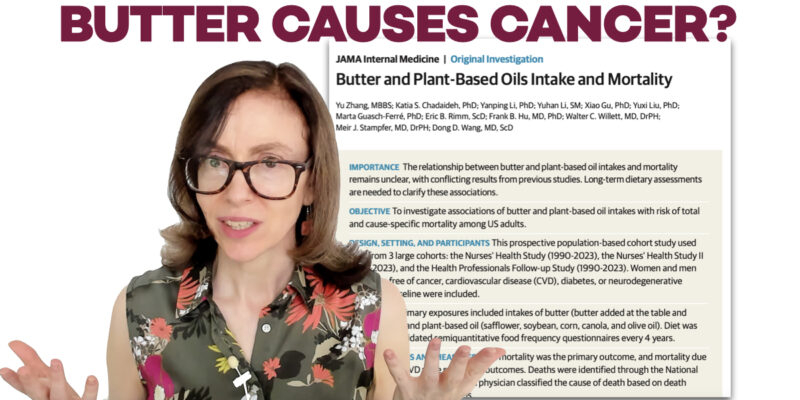
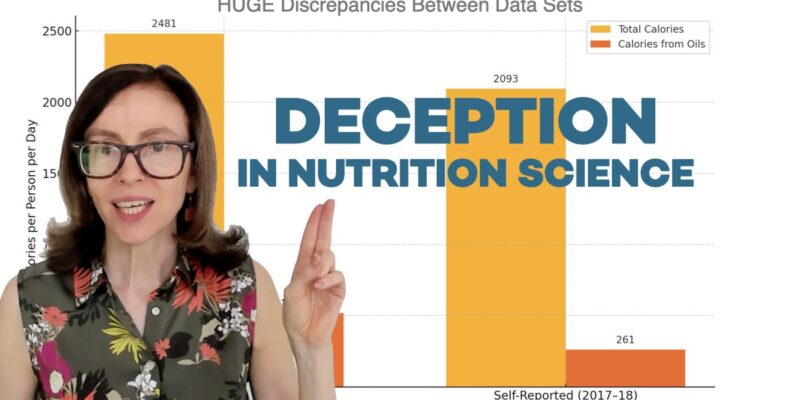
JAMA Internal Medicine published the first-ever study comparing butter to seed oils. But they skewed the data to the point of absurdity.
Time and again, I’ve seen supposedly peer-reviewed studies making conclusions that defy common sense. Especially seed oil studies. This latest journal is one of the worst examples I’ve come across. I’m going to break down what they did and how they got away with it in this article.
Their paper is especially important. It’s the first, to my knowledge, to compare seed oils head to head with butter. More than 70 years have passed since health authorities started recommending we swap out butter for seed oils. In all that time, our authorities said they had studies showing that seed oils had health benefits over butter. But they didn’t.
Previous studies lumped butter in with other animal fats. Or they investigated saturated fat rather than any whole food. Similarly, they lumped the collection of problematic seed oils I call the Hateful Eight together with olive oil and other plant fats. Or they investigated linoleic acid rather than any whole food.
This article is continued below...(scroll down)


It helped. I feel great.
"It’s helped. I feel great."
Kobe Bryant
NBA baskeball player

This has been life changing
"Let me tell you this has been life-changing. I have all of her books, in audible and ebooks! I have gotten rid of all the hateful 8 oils. I have trained my body to eat its own previously toxic body fat. Download that pod it's a game changer!"
Megyn Kelly
Broadcaster / The Megyn Kelly Show

Life changing
Deep Nutrition changed my life.
Jesse Watters
Fox News Primetime host
Saved my life
I would like to thank you for literally saving my life. Back in February, I had to be hospitalized while on vacation in Phoenix with an A1C of 11% and had to start taking 2 types of insulin and 2 other meds. I read the Fatburn Fix in April, and followed the program to a tee, and I’m down by 15 pounds, 6.8 A1C, and only one once weekly diabetes medicine. Prior to reading the book, it was almost impossible for me to lose weight as a diabetic.
Leontyne Tompkins
I feel free
For the last month, I have really been reading all labels on everything. I have completely remove those 8 oils you talk about. I must tell you, I feel great! I have more energy and I am now 197 lbs (have always been around 205 to 210lbs). I eat potatoes with real butter, grass fed steak, pasta with the right toppings. I eat everything! I seem to crave less sugar. I love it!
Robert Kirkendall
I feel so much better
I had terrible aches and pains everywhere in my body, my hands, shoulders and knees. I feel so much better and the way I feel is motivating me every day! Thank you
Mike Deb Wootan Burcin
Better than ever
I am an anesthesiologist in Orlando and a huge fan of both of your books! I have been incorporating your principles for the last 10 months and feel that my health is better than ever.
Marnie Robinson, MD
My allergies disappeared
The biggest difference for me (and a surprising one) is that my allergies have almost completely disappeared! This is a big deal for me, because I’ve had allergies most of my life and they have often affected what I do which is a teaching music in [a public school district]. In general, I feel much better and have more consistent energy throughout the day.
Erica Turrell
Heart Palpitations have Stopped
I’ve lost 20+ pounds (also fasting 16-24 hours daily) and haven’t had palpitations except for one occasion — I had a mini bag of Fritos for the first time in July. And, I feel better now on a daily basis than I ever did all through college.
Mike Wright
Deep Nutrition and Fatburn Fix reader
I’ve lost over 50 pounds
I’ve lost over 50 pounds. I’m 56 years old. Cutting processed food and unhealthy fats from my diet was one of the first things I did on my health recovery journey...I went cold turkey off the bad oils. Emptied my pantry into the trash and just started eating real food
Mitzi Wilkinson Champion
Knowledge I didn’t know I needed
Your Fatburn Fix book is amazing, my friend. Thank you! I’m an Functional Nutritional Therapy Practitioner and I know my stuff. This is the extra layer of knowledge I didn’t know I needed. Well done!
Jennifer Dillman
Fatburn Fix reader
Lost a solid 20 lbs and my bloodwork is great
I have lost a solid 20 lbs and my bloodwork (after 3 months of eating your way) was even better! I was metabolically healthy (per your book) before I read your book, but barely. Lowering my weight, sealed the deal! I have been talking about you and your book to anyone who will listen...Thank you for all you’ve done and what you continue to do! You are changing lives for the better!
Missy Cramer
FatBurn Fix reader
Lost 20 lbs I could never shed
I love your Fatburn Fix! Has helped me so so much! I have had the dreaded weight all my life - 20 or so pounds I could never shed. I have lost that now. I only eat 2 meals a day lunch and dinner with a glass of milk or cappuccino around 4 to hold me over. No snacking and not bad oils. It has been the key to unlocking my fatburn. I work out in the am and believe I am burning fat for energy not from food!
Lauren Smith
I feel great
My waist is four inches smaller. I feel great and many of the minor aches and pains that I had (knees and lower back) are gone. Also, my muscle tone is amazing, even though I have not increased my workout routine.
Richard Janelle
Completed Dr Cate's online course

The go-to for strength and conditioning coaches
Whenever I advise my clients about eating to perform I go straight to what I have learned from Dr. Cate. Her book Deep Nutrition has become the go-to for strength and conditioning coaches across the country.
Kent Matthes
Major League Baseball Agent with WME Sports

Dismantles the lie
Dr. Cate dismantles the lie that seed oils are healthy, which may the biggest lie about nutrition and health because it’s so insidious.
Ken D Berry, MD
Author of Lies My Doctor Told Me

She knows the chemistry
Dr. Cate alerts us to the harms of seed oils and she’s convincing because she knows the chemistry better than anyone.
Dr. Drew Pinskey, MD
Globally recognized internal medicine and addiction medicine specialist, media personality, LoveLine Host, and New York Times bestselling author

No one is better at communicating nutritional truth
Dr. Cate has had the single greatest impact on how we talk to people about fueling for both performance or durability. While we all are a little unique, the foundational principles of human nutrition are immutable. If you are looking to create a more durable, resilient body, no one is better at communicating nutritional truth than Dr. Cate.
Dr. Kelly Starrett
Physiotherapist coach and New York Times and Wall Street Journal bestselling author

Highly recommend The Fatburn Fix
Dr. Shanahan has had a significant impact on my practice of medicine. I am known as a Low Carb Doctor, but I never really appreciated the negative effects of processed seed oils on the health of my patients. I highly recommend The Fatburn Fix to my patients and have a loaner copy in my waiting room. It is amazing how quickly blood sugars and overall health improves with cutting seed oils. It is not just about the carbs!
Dr. Brian Lenkzes, MD
CEO of LowCarbMD San Diego, co-host of Low Carb MD Podcast and host of Life's Best Medicine Podcast

Respected in the sports world
Dr. Cate reordered my diet when I was with the L.A. Lakers, and the benefits, for me personally, were felt immediately and have served me to this day. I’ve come to take real food so seriously I started a small family farm. I know of no M.D./nutritionist more respected in the sports world than Dr. Cate Shanahan.
Chris Kaman
NBA Player

Brought seed oil issue front and center
Cate brought the seed oil issue front and center. Healthy fats matter. So much so that I created an entire product line to swap out bad fats with good.
Mark Sisson
Founding Father of the Primal/Paleo Movement

Optimal health starts with food
If you want to understand how optimal health starts with food, start with Dr. Cate. Her book Deep Nutrition leaves you with an appreciation of the profound relationship between our genes and the planet, inspiring us to be good shepherds of both.
Dallas Hartwig
Attribution author of The Whole 30

Helped me with endurance
Deep Nutrition really helped me with endurance. I started to feel better as a player. I was able to run more, I was able to be more active …and I just decided to keep going with it to this day.
Dwight Howard
NBA Player

Silver bullet for me
Dr Cate’s teachings helped me lose 60 pounds like it was nothing. It was like a silver bullet for me.
Paul Grewal, MD
Dr Grewal Internal Medicine, MD, author of Genius Foods

Radically improve your health…
Dr. Shanahan has provided a solid reference that deserves a place in the library of anyone who is seriously interested in nutrition. Her perspective on the vital role that healthy fat has in our diet is novel and, if implemented, can radically improve your health.
Dr. Joseph Mercola
Author of Fat for Fuel and Founder of Mercola.com

Pull up a chair…
I have based my work on the idea that getting the right kinds of healthy fats into your body and avoiding the worst fats is essential to optimal health. I've interviewed dozens of the world's top experts about this, and I know of no one who speaks more eloquently on this topic than Dr Cate. If she’s talking fats, pull up a chair. Take notes.
Dave Asprey
Author of the Bulletproof Diet
The key to unlocking my fatburn
I love your Fatburn Fix! Has helped me so so much! I have had the dreaded weight all my life - 20 or so pounds I could never shed. I have lost that now. I only eat 2 meals a day lunch and dinner with a glass of milk or cappuccino around 4 to hold me over. No snacking and not bad oils. It has been the key to unlocking my fatburn.
Lauren Smith
Saved my life
I would like to thank you for literally saving my life. Back in February, I had to be hospitalized while on vacation in Phoenix with an A1C of 11% and had to start taking 2 types of insulin and 2 other meds. I read the Fatburn Fix in April, and followed the program to a tee, and I’m down by 15 pounds, 6.8 A1C, and only one once weekly diabetes medicine.
Leontyne Tompkins
> Tears of joy
I'm crying tears of joy and appreciation for all you've done for me and my health! Without Deep Nutrition and Fatburn Fix, I would literally still be in the vicious cycle I'd been fighting all my life! In a nutshell - I am no longer a compulsive overeating addict suffering under the crushing 'thumb' of all food and alcohol.
Penni Wicks
So this truly is a first. At least to my knowledge.
Let’s start by talking about the claim that’s making headlines.
Exchanging 10 grams of butter for seed oil reduces total mortality and cancer mortality by 17%, while also reducing heart disease mortality.
That’s a huge effect. But let’s think about what they’re saying here for just a bit.
Total mortality includes cancer mortality and heart disease mortality. So when they say total mortality and cancer mortality can be cut by 17 percent by avoiding butter, that suggests all the excess deaths the seed-oil eaters avoided come from cancer. But, wait. The authors also claim that heart disease deaths were reduced as well. That would mean seed oils confer a less than zero chance of dying.
Now, I’m no statistician, but that’s pretty improbable. When I posted this on social media, experts came out of the woodwork to say things like “I can’t even begin to say how wrong that is.” Hmmm. If it’s that hard to explain, maybe you should question it.
I think we all know that statisticians can make 17 minus 17 not equal zero any day of the week. They can make a bunch of extrapolations and adjustments. They can use a skewed data set. And the editors rarely require them to reveal the raw data that they adjusted and extrapolated. That’s true in this case (no raw mortality data provided), and the butter and oil intakes were skewed to the point of ridiculousness.
Let’s start with a look at the skewed data.
Quartiles Became Levels
Normally, studies like this break people’s consumption into groups that are evenly sized. They did not do this here. They intended to, but because butter and oil intakes were highly right-skewed, meaning most data points were clustered at the lower end, but a few extremely high values pulled the mean to the right of the median. (This comes from the inaccurate reporting problem discussed below.) The authors acknowledge this directly in the Statistical Analysis section, where they state:
“Participants were initially categorized into quartiles of intake levels; however, due to the right-skewed distribution of these exposures, the sample sizes within each category were uneven. Therefore, we labeled the categories as levels 1 to 4 instead of quartiles 1 to 4.”
This is an admission that these are not quartiles in any meaningful sense. Just to show you one example of the imbalance using the Nurses’ Health Study butter intake data:
Number of participants in each level:
-
Level 1: 53,415
-
Level 2: 6,488
-
Level 3: 2,156
-
Level 4: 1,049
That is not remotely quartile-like. There should be roughly 15,000 in each quartile. This is so out of the ordinary and flawed that one scientist has said, “such skewed allocation is absurd and the ‘research’ should have stopped there.” I couldn’t agree more.
Now let’s move on to understanding why that “highly right-skewed” data is a big problem in and of itself.
Butter and Seed Oil Intakes Difficult to Believe.
Reported butter intake from the Nurses’ Health Study is skewed low.
According to Table 1, a pound of butter would feed most families for years.
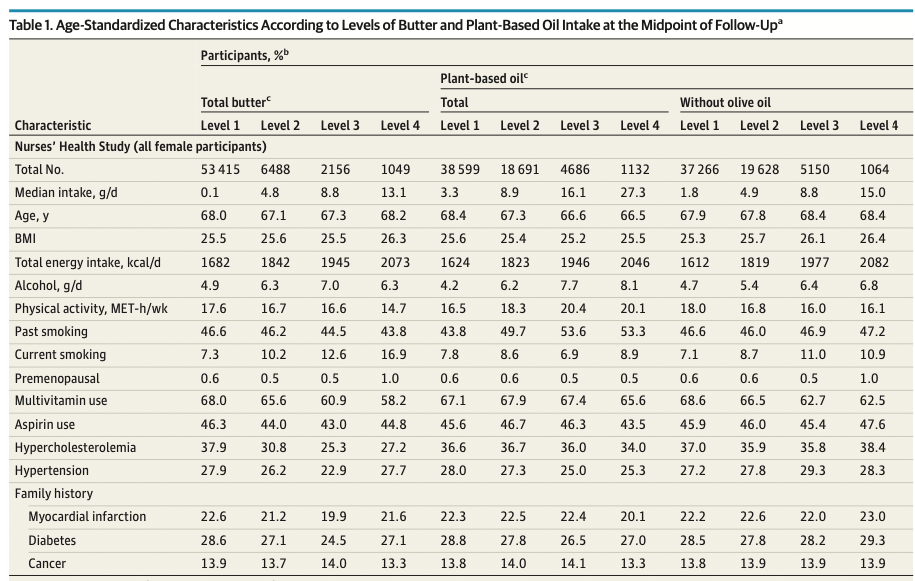
Zooming in to look at the butter intakes, we see this:
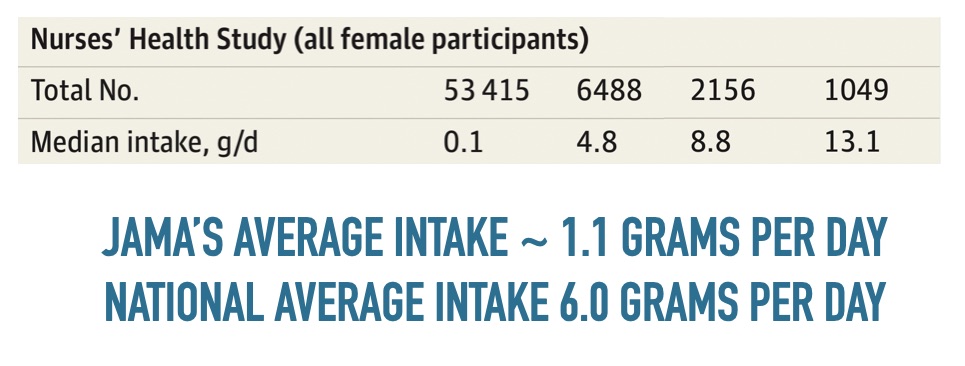
According to Table 1, the median butter serving among most of the participants surveyed in 2002 (63,108 of 53,415) was 0.1 grams per day. In a year, they’d eat 36.5 grams. But wait, the average butter consumption in the US around that time was 60 times higher, 2.2 kg per year. [See table 2 in this article, which reports 1999 data] So they’re asking us to believe that the vast majority of study participants, 82% or so, consumed so much less butter than average that it’s statistically a miracle that they found so many of them.
It’s been a while since I took my two-credit course on statistics in med school, but I think the proper term to describe that kind of result starts with a B and ends with an S.
Another part of Table 1, not shown here, also reports butter consumption from two other very large data sets: the Nurses’ Health Study II (NHSII) and the Health Professionals Follow-up Study (HPFS). The results are also much lower than average and difficult to believe.
Next, let’s look at the seed oil data from the Nurses’ Health Study.
The paper reports that the median serving of seed oil for a majority, 37,266 of the 63,108 people surveyed, in 2002 was 1.8 grams per day. In a year, they’d consume 657 grams. That’s just under half of one of those 24-ounce bottles you can buy for $4 or so. But here again, when we compare to the average person’s estimated consumption, we see a discrepancy [see figure 1 in this paper].
According to more reliable data, in 1999, the average person’s soy and canola consumption was 20 times higher than the majority of Nurses’ Health Study participants.
(The same goes for the data in the two other studies the authors analyzed. In the interest of space, I’m not going to break them down.)
According to Zhang et al, a majority of participants consumed so much less seed oil than average that their total reported consumption amounts to a rounding error in the average consumption at that time.
How do they get away with this?
I’m going to show you in the next section.

What should we make of these reported butter and seed oil consumption discrepancies?
These discrepancies are huge. Yooooj. Why didn’t the authors mention them?
I can think of two reasons. Either they were completely unaware of average consumption levels. Or they did not want to highlight the fact that their data appears to deviate so far from reality that it’s simply not believable. If it’s option one, then we have people calling themselves nutrition experts who are not. If it’s option two, we have dishonest people running the nutrition conversation. Heck, they might even fill in the data tables with fake numbers if they think they can get away with it!
I don’t actually think they printed fake consumption data. I do think they intentionally skewed the data.
Let’s focus on how they skewed the butter intake data.
According to the authors, “Total butter intake was calculated by multiplying the frequency of consumption by 5 g per pat from the sum of 3 FFQ items: butter from butter and margarine blend, spreadable butter added to food and bread (excluding cooking), and butter used in baking and frying at home.”
They did not asses any butter used as cooking fat, or melted and added to vegetables, pancakes, puddings, frostings, cookies, cakes, muffins, desserts, etc. They did not assess any butter consumed outside the home. Restaurants use butter for all of the above purposes. Bakeries use a ton of butter.
The know-it-alls on social media have told me that I’m wrong to suggest any malfeasance here. They say this is just a problem with food frequency questionnaires, which are notoriously inaccurate. They don’t realize they are making my point, which is this: we shouldn’t be using data from flawed food frequency questionnaires to draw any conclusions.
The average calorie intake is also strikingly low.
Check out the calorie data reported under “Total energy intake, kcal/d” in the table I copied above. Participants, who are all women in this study, ate 1682 calories per day. At the time, the average American woman was getting 1877 calories daily. This represents 200 calories fewer than average.
Again, no mention of this either. The authors understandably would not want to draw attention to the flaws in their dataset. It’s understandable. But it’s not ethical.
The biggest names in nutrition science are misleading us.
You might expect that a deviant article like this would come from a group of hacks at a minor university. But take a look. The authors include some of the biggest names in nutrition science, and five of the six are at Harvard. Walter Willett has over 2,000 publications, and Frank Hu has over 1500.
Here’s the bottom line: Nutrition science is no longer science.
Leading nutrition scientists chuffed out a fundamentally flawed article and are not being held accountable (so far). This article is being used to support the continued production and usage of seed oils by every consumer and every processed food company. This is hardly the first flawed article reporting on seed oils. It’s time for dietitians, doctors, and patients who trust these licensed health professionals to wake up. Nutrition science has been completely hijacked by the processed food industry, which fuels the diseases that the pharmaceutical industry feeds upon.
Want to know who to trust? Trust your own sense of logic. Trust you.
Read about the real cause of heart disease. It’s not butter.
Read about the harms of cholesterol-lowering drugs: here, here, here, and here.
Have a burning question about good fats and bad? The answers are on this page.
Want to know why seed oils are so unhealthy? I’ve answered those questions, too, right here.

Related Posts
This Post Has 13 Comments
Note: Please do not share personal information with a medical question in our comment section. Comments containing this content will be deleted due to HIPAA regulations.

why don’t you publish your work in peer reviewed journals?
Until recently, journals refused to publish folks like me without active University affiliations! But that’s changed recently. I now have 2 publications.
Link to the study, please? Cannot seem to find it anywhere…
It’s on pubmed but there is no free full text anywhere, unfortunately. I’ll add a link to pubmed.
I’ve read both your books, The Fatburn Fix and Dark Calories which prove beyond a shadow of doubt that seed oils are toxic. Indeed, pure poison during much of their manufacturing process. I eat organic butter daily, as I did growing up on a dairy farm in the 50’s and 60’s, everything else I eat is organic now, as it was then. I’ve lost weight since I began following your program and at 75 feel better and am healthier than I have been since those days as child, before artificial fertilizers and any kind of seed oil. You’re right. I’m still astounded that virtually all medical practitioners know so little about proper nutrition. Thank you!
Reading this makes me so happy. Thank you!
Great read.Happy Easter.
I consume roughly 15 to 20 pounds of pastured butter a year. I gave up 95% of the hateful 8 many years ago (long before I read your books). And to lump olive oil and other more healthy plant oils in along with the hateful 8 as if they are all equivalent nutritionaly is really bad science to start with. Even butter is not “all the same”. I’ll take the golden stuff (grassfed) over the white stuff (conventional feed) anyday.
Keep up the good work!
Yes we need to make butter great again.
I knew it was fake immediately partly because I read your book but also common sense, they tried it with high fructose corn syrup and also with many vaccines.
I sincerely hope RFK Jr points out the lies and deceit in this “study”
My wife and I are in our own n=2 study of the health effects of eliminating all forms of seed oil. I’m certain we consume much more than a kilogram of grass-fed butter each year. Now in our late 70s, we have never been as healthy as we are now. All of our labs are ideal, with the exception of cholesterol. This is not a concern, since many studies are now showing the higher LDL numbers in older people leads to reduced mortality, and lowers the risk of dementia. A phrase, sometimes attributed to Mark Twain, covers studies like this one: Lies, damned lies, and statistics. I have my own opinion piece on the subject: https://jimthegeek.substack.com/p/dark-harvest?utm_source=publication-search
As the saying goes, follow the money.
Thank you for this rebuttal of their study. Having a degree in BS, you are very astute in recognizing it.
Again you are correct in identifying their “shortcomings”. I think they have a combination of both dishonesty and ignorance hence I shall refer to them as dishonest idiots. Harvard has lost all of its importance of a higher institute of education but has become merely a biased political mouthpiece. It’s a shame we teach our young people what to think rather than how to think based on ALL facts.
Keep sharing your insights and making a difference.
Great info Kate. I am not a scientist or a Dr. Just an average bloke who looks at the history which shows heart attacks and cancer was lower when we ate meat, butter, eggs, dairy and no processed food, or snacks.