
Why It Matters That Seed Oils Are Being Recognized as Ultra-Processed The US Dietary Guidelines…
Is Coffee Bad For Your Health?
Coffee: Friend or Foe?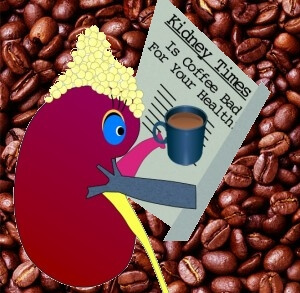
Coffee is one of the most popular breakfast items on the most popular diet (a Paleo Diet) menu. Indeed, I’ve read reports claiming that coffee has antioxidants that may prevent heart disease and other compounds that may help to prevent certain cancers.
At the other end of the argument, many natural health newsletters treat coffee like it’s worse than cocaine–blaming coffee for everything from “burning out” our adrenal glands and harming our kidneys, to mood swings, fatigue, and depression.
So is starting your day with coffee really going to make you “Bulletproof”?
This article is continued below...(scroll down)


It helped. I feel great.
"It’s helped. I feel great."
Kobe Bryant
NBA baskeball player

This has been life changing
"Let me tell you this has been life-changing. I have all of her books, in audible and ebooks! I have gotten rid of all the hateful 8 oils. I have trained my body to eat its own previously toxic body fat. Download that pod it's a game changer!"
Megyn Kelly
Broadcaster / The Megyn Kelly Show

Life changing
Deep Nutrition changed my life.
Jesse Watters
Fox News Primetime host
Saved my life
I would like to thank you for literally saving my life. Back in February, I had to be hospitalized while on vacation in Phoenix with an A1C of 11% and had to start taking 2 types of insulin and 2 other meds. I read the Fatburn Fix in April, and followed the program to a tee, and I’m down by 15 pounds, 6.8 A1C, and only one once weekly diabetes medicine. Prior to reading the book, it was almost impossible for me to lose weight as a diabetic.
Leontyne Tompkins
I feel free
For the last month, I have really been reading all labels on everything. I have completely remove those 8 oils you talk about. I must tell you, I feel great! I have more energy and I am now 197 lbs (have always been around 205 to 210lbs). I eat potatoes with real butter, grass fed steak, pasta with the right toppings. I eat everything! I seem to crave less sugar. I love it!
Robert Kirkendall
I feel so much better
I had terrible aches and pains everywhere in my body, my hands, shoulders and knees. I feel so much better and the way I feel is motivating me every day! Thank you
Mike Deb Wootan Burcin
Better than ever
I am an anesthesiologist in Orlando and a huge fan of both of your books! I have been incorporating your principles for the last 10 months and feel that my health is better than ever.
Marnie Robinson, MD
My allergies disappeared
The biggest difference for me (and a surprising one) is that my allergies have almost completely disappeared! This is a big deal for me, because I’ve had allergies most of my life and they have often affected what I do which is a teaching music in [a public school district]. In general, I feel much better and have more consistent energy throughout the day.
Erica Turrell
Heart Palpitations have Stopped
I’ve lost 20+ pounds (also fasting 16-24 hours daily) and haven’t had palpitations except for one occasion — I had a mini bag of Fritos for the first time in July. And, I feel better now on a daily basis than I ever did all through college.
Mike Wright
Deep Nutrition and Fatburn Fix reader
I’ve lost over 50 pounds
I’ve lost over 50 pounds. I’m 56 years old. Cutting processed food and unhealthy fats from my diet was one of the first things I did on my health recovery journey...I went cold turkey off the bad oils. Emptied my pantry into the trash and just started eating real food
Mitzi Wilkinson Champion
Knowledge I didn’t know I needed
Your Fatburn Fix book is amazing, my friend. Thank you! I’m an Functional Nutritional Therapy Practitioner and I know my stuff. This is the extra layer of knowledge I didn’t know I needed. Well done!
Jennifer Dillman
Fatburn Fix reader
Lost a solid 20 lbs and my bloodwork is great
I have lost a solid 20 lbs and my bloodwork (after 3 months of eating your way) was even better! I was metabolically healthy (per your book) before I read your book, but barely. Lowering my weight, sealed the deal! I have been talking about you and your book to anyone who will listen...Thank you for all you’ve done and what you continue to do! You are changing lives for the better!
Missy Cramer
FatBurn Fix reader
Lost 20 lbs I could never shed
I love your Fatburn Fix! Has helped me so so much! I have had the dreaded weight all my life - 20 or so pounds I could never shed. I have lost that now. I only eat 2 meals a day lunch and dinner with a glass of milk or cappuccino around 4 to hold me over. No snacking and not bad oils. It has been the key to unlocking my fatburn. I work out in the am and believe I am burning fat for energy not from food!
Lauren Smith
I feel great
My waist is four inches smaller. I feel great and many of the minor aches and pains that I had (knees and lower back) are gone. Also, my muscle tone is amazing, even though I have not increased my workout routine.
Richard Janelle
Completed Dr Cate's online course

The go-to for strength and conditioning coaches
Whenever I advise my clients about eating to perform I go straight to what I have learned from Dr. Cate. Her book Deep Nutrition has become the go-to for strength and conditioning coaches across the country.
Kent Matthes
Major League Baseball Agent with WME Sports

Dismantles the lie
Dr. Cate dismantles the lie that seed oils are healthy, which may the biggest lie about nutrition and health because it’s so insidious.
Ken D Berry, MD
Author of Lies My Doctor Told Me

She knows the chemistry
Dr. Cate alerts us to the harms of seed oils and she’s convincing because she knows the chemistry better than anyone.
Dr. Drew Pinskey, MD
Globally recognized internal medicine and addiction medicine specialist, media personality, LoveLine Host, and New York Times bestselling author

No one is better at communicating nutritional truth
Dr. Cate has had the single greatest impact on how we talk to people about fueling for both performance or durability. While we all are a little unique, the foundational principles of human nutrition are immutable. If you are looking to create a more durable, resilient body, no one is better at communicating nutritional truth than Dr. Cate.
Dr. Kelly Starrett
Physiotherapist coach and New York Times and Wall Street Journal bestselling author

Highly recommend The Fatburn Fix
Dr. Shanahan has had a significant impact on my practice of medicine. I am known as a Low Carb Doctor, but I never really appreciated the negative effects of processed seed oils on the health of my patients. I highly recommend The Fatburn Fix to my patients and have a loaner copy in my waiting room. It is amazing how quickly blood sugars and overall health improves with cutting seed oils. It is not just about the carbs!
Dr. Brian Lenkzes, MD
CEO of LowCarbMD San Diego, co-host of Low Carb MD Podcast and host of Life's Best Medicine Podcast

Respected in the sports world
Dr. Cate reordered my diet when I was with the L.A. Lakers, and the benefits, for me personally, were felt immediately and have served me to this day. I’ve come to take real food so seriously I started a small family farm. I know of no M.D./nutritionist more respected in the sports world than Dr. Cate Shanahan.
Chris Kaman
NBA Player

Brought seed oil issue front and center
Cate brought the seed oil issue front and center. Healthy fats matter. So much so that I created an entire product line to swap out bad fats with good.
Mark Sisson
Founding Father of the Primal/Paleo Movement

Optimal health starts with food
If you want to understand how optimal health starts with food, start with Dr. Cate. Her book Deep Nutrition leaves you with an appreciation of the profound relationship between our genes and the planet, inspiring us to be good shepherds of both.
Dallas Hartwig
Attribution author of The Whole 30

Helped me with endurance
Deep Nutrition really helped me with endurance. I started to feel better as a player. I was able to run more, I was able to be more active …and I just decided to keep going with it to this day.
Dwight Howard
NBA Player

Silver bullet for me
Dr Cate’s teachings helped me lose 60 pounds like it was nothing. It was like a silver bullet for me.
Paul Grewal, MD
Dr Grewal Internal Medicine, MD, author of Genius Foods

Radically improve your health…
Dr. Shanahan has provided a solid reference that deserves a place in the library of anyone who is seriously interested in nutrition. Her perspective on the vital role that healthy fat has in our diet is novel and, if implemented, can radically improve your health.
Dr. Joseph Mercola
Author of Fat for Fuel and Founder of Mercola.com

Pull up a chair…
I have based my work on the idea that getting the right kinds of healthy fats into your body and avoiding the worst fats is essential to optimal health. I've interviewed dozens of the world's top experts about this, and I know of no one who speaks more eloquently on this topic than Dr Cate. If she’s talking fats, pull up a chair. Take notes.
Dave Asprey
Author of the Bulletproof Diet
The key to unlocking my fatburn
I love your Fatburn Fix! Has helped me so so much! I have had the dreaded weight all my life - 20 or so pounds I could never shed. I have lost that now. I only eat 2 meals a day lunch and dinner with a glass of milk or cappuccino around 4 to hold me over. No snacking and not bad oils. It has been the key to unlocking my fatburn.
Lauren Smith
Saved my life
I would like to thank you for literally saving my life. Back in February, I had to be hospitalized while on vacation in Phoenix with an A1C of 11% and had to start taking 2 types of insulin and 2 other meds. I read the Fatburn Fix in April, and followed the program to a tee, and I’m down by 15 pounds, 6.8 A1C, and only one once weekly diabetes medicine.
Leontyne Tompkins
> Tears of joy
I'm crying tears of joy and appreciation for all you've done for me and my health! Without Deep Nutrition and Fatburn Fix, I would literally still be in the vicious cycle I'd been fighting all my life! In a nutshell - I am no longer a compulsive overeating addict suffering under the crushing 'thumb' of all food and alcohol.
Penni Wicks
Moderation is the key.
Those who know me will tell you I’m not a big believer in “everything” in moderation. In this case, however, I think that advice is not too far off.
What I suggest. If you like coffee (as I do), enjoy a cup or two per day with plenty of organic, whole milk or cream. If you don’t like dairy in your coffee, have some other source of protein and saturated fat along with it. The protein and fat help moderate caffeine’s effect on your brain, preventing over-stimulation which leads to fatigue.
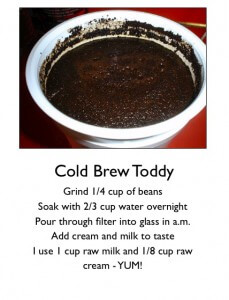
My favorite coffee:
Coffee, Chemicals, and Nervous System Stimulation.
If you’re used to four cups a day, cutting down to one cup may seem a pretty tall order. That’s because of the particularly addictive drugs coffee contains.
What are the chemicals in coffee?
They include caffeine, theobromine, theophylline, methylxanthine, and a host of others. These chemicals are also present in tea, chocolate, and nearly 60 other commonly consumed seeds, herbs, and vegetables–though typically in much lower concentrations. No matter the source, these chemicals tend to appear together in foods, so to simplify, I’ll refer to the whole mixture as the “caffeine family.”
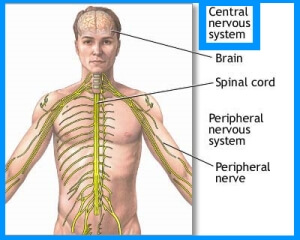 Central nervous system. The caffeine family molecules exert their stimulating effect via the nervous system, and each chemical has an affinity for slightly different types of nerves:
- Theobromine affects nerves in the gastric system most strongly.
- Theophylline stimulates nerves in the lungs and heart.
- Methylxanthines (which include caffeine), impact the brain.
The effects that coffee has on us.
Herein is the key to understanding coffee’s mass appeal. Methylxanthines affect brain cells that release adrenaline, dopamine, and serotonin. Each of those influences arousal, vigilance, coordination, fatigue, and mood in varying and interdependent ways. The net effect can instill a person with more of a “can-do” attitude than they might otherwise enjoy and jump-start the day’s work.
There is no evidence for “tolerance” to caffeine. In other words, if we start our day with a single cup of coffee in the morning, as the months and years go by, we won’t need to up the dosage to get the same effect. Alcohol consumption, in contrast, does lead to tolerance.
A closer look at caffeine and our brain.
The caffeine family of chemicals interferes with an enzyme in nerve cells (cyclic AMP) that breaks down a signaling chemical. As a result,  any stimulation that a nerve cell receives will last a little longer. That’s true whether that nerve cell is in our brain, our gut, or our heart. Thus, in the same way that serotonin reuptake inhibitor antidepressants allow serotonin to exert its effect for a longer time, caffeine keeps cyclic AMP from being broken down as quickly.
Caffeine doesn’t damage the enzyme; it slows down its function temporarily by a mechanism called “competitive inhibition.” Caffeine “competes” with other factors to inhibit the enzyme. Thus, caffeine’s effects on our bodies are both completely reversibly and highly variable, dependent not only on the dose but also on what other factors might be modulating the enzyme’s activity. These factors include blood sugar level, time of day, fatigue, how tired we are and why we’re tired (sleep loss versus emotional versus physical), as well as the kinds of foods we consume.
Some effects are also genetic, most notably the fact that a minority of women will develop painful breast cysts from drinking caffeine. All these effects can be exaggerated or eliminated depending on the circumstances surrounding our caffeine consumption.
Conclusion.
Sleep, exercise, good food, drinking plenty of water, and one cup of coffee is a lifestyle “house blend” we can all live with.
The best way to receive all drcate.com updates is to subscribe and you’ll also get a bunch of great resources delivered (one time) to your inbox as a thank-you.

Related Posts

This Post Has One Comment
Note: Please do not share personal information with a medical question in our comment section. Comments containing this content will be deleted due to HIPAA regulations.

What about for women who are pregnant? Recommendations say under 200mg per day is acceptable—are there any potential negative impacts on the baby from that level of consumption?