
What A Coronary Calcium Test Can—and Can't—Tell You About Your Heart Attack Risk The way…
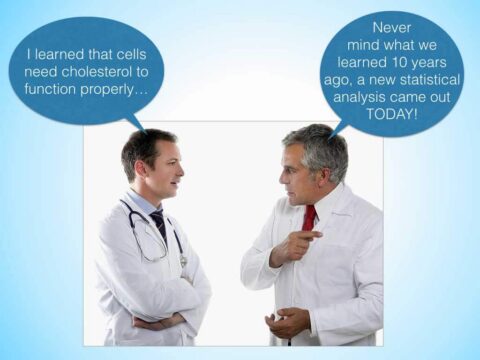
Journal Articles Can Easily Mislead Doctors About Statin (or any) Drug Safety
Doctors don’t go to medical school to become expert at interpreting statistics. Yet most of the articles that tell us how safe drugs might be rely on complex statistical analyses that go far beyond what I learned in my one credit course on Statistics for Medical Practitioners. For the most part, doctors have to take the word of the statisticians on whether a drug has a given benefit or harm.
An example is a recent Lancet review article has been hailed as the “definitive” summary of the potential risks versus potential harms of statin drugs. The authors conclude that most of the side effects we’ve thought statins had are actually nonexistent. They predict just 2 adverse events per 15 cases of heart attack or stroke prevented, and make rather strong statements about doctors not prescribing statins often enough.
A couple of folks I respect have pointed out that the authors have long served as apologists for the statin industry. In my video critique of the Lancet article I discuss Malcolm Kendrick, and HealthInsightUK.
This article is continued below...(scroll down)


It helped. I feel great.
"It’s helped. I feel great."
Kobe Bryant
NBA baskeball player

This has been life changing
"Let me tell you this has been life-changing. I have all of her books, in audible and ebooks! I have gotten rid of all the hateful 8 oils. I have trained my body to eat its own previously toxic body fat. Download that pod it's a game changer!"
Megyn Kelly
Broadcaster / The Megyn Kelly Show

Life changing
Deep Nutrition changed my life.
Jesse Watters
Fox News Primetime host
Saved my life
I would like to thank you for literally saving my life. Back in February, I had to be hospitalized while on vacation in Phoenix with an A1C of 11% and had to start taking 2 types of insulin and 2 other meds. I read the Fatburn Fix in April, and followed the program to a tee, and I’m down by 15 pounds, 6.8 A1C, and only one once weekly diabetes medicine. Prior to reading the book, it was almost impossible for me to lose weight as a diabetic.
Leontyne Tompkins
I feel free
For the last month, I have really been reading all labels on everything. I have completely remove those 8 oils you talk about. I must tell you, I feel great! I have more energy and I am now 197 lbs (have always been around 205 to 210lbs). I eat potatoes with real butter, grass fed steak, pasta with the right toppings. I eat everything! I seem to crave less sugar. I love it!
Robert Kirkendall
I feel so much better
I had terrible aches and pains everywhere in my body, my hands, shoulders and knees. I feel so much better and the way I feel is motivating me every day! Thank you
Mike Deb Wootan Burcin
Better than ever
I am an anesthesiologist in Orlando and a huge fan of both of your books! I have been incorporating your principles for the last 10 months and feel that my health is better than ever.
Marnie Robinson, MD
My allergies disappeared
The biggest difference for me (and a surprising one) is that my allergies have almost completely disappeared! This is a big deal for me, because I’ve had allergies most of my life and they have often affected what I do which is a teaching music in [a public school district]. In general, I feel much better and have more consistent energy throughout the day.
Erica Turrell
Heart Palpitations have Stopped
I’ve lost 20+ pounds (also fasting 16-24 hours daily) and haven’t had palpitations except for one occasion — I had a mini bag of Fritos for the first time in July. And, I feel better now on a daily basis than I ever did all through college.
Mike Wright
Deep Nutrition and Fatburn Fix reader
I’ve lost over 50 pounds
I’ve lost over 50 pounds. I’m 56 years old. Cutting processed food and unhealthy fats from my diet was one of the first things I did on my health recovery journey...I went cold turkey off the bad oils. Emptied my pantry into the trash and just started eating real food
Mitzi Wilkinson Champion
Knowledge I didn’t know I needed
Your Fatburn Fix book is amazing, my friend. Thank you! I’m an Functional Nutritional Therapy Practitioner and I know my stuff. This is the extra layer of knowledge I didn’t know I needed. Well done!
Jennifer Dillman
Fatburn Fix reader
Lost a solid 20 lbs and my bloodwork is great
I have lost a solid 20 lbs and my bloodwork (after 3 months of eating your way) was even better! I was metabolically healthy (per your book) before I read your book, but barely. Lowering my weight, sealed the deal! I have been talking about you and your book to anyone who will listen...Thank you for all you’ve done and what you continue to do! You are changing lives for the better!
Missy Cramer
FatBurn Fix reader
Lost 20 lbs I could never shed
I love your Fatburn Fix! Has helped me so so much! I have had the dreaded weight all my life - 20 or so pounds I could never shed. I have lost that now. I only eat 2 meals a day lunch and dinner with a glass of milk or cappuccino around 4 to hold me over. No snacking and not bad oils. It has been the key to unlocking my fatburn. I work out in the am and believe I am burning fat for energy not from food!
Lauren Smith
I feel great
My waist is four inches smaller. I feel great and many of the minor aches and pains that I had (knees and lower back) are gone. Also, my muscle tone is amazing, even though I have not increased my workout routine.
Richard Janelle
Completed Dr Cate's online course

The go-to for strength and conditioning coaches
Whenever I advise my clients about eating to perform I go straight to what I have learned from Dr. Cate. Her book Deep Nutrition has become the go-to for strength and conditioning coaches across the country.
Kent Matthes
Major League Baseball Agent with WME Sports

Dismantles the lie
Dr. Cate dismantles the lie that seed oils are healthy, which may the biggest lie about nutrition and health because it’s so insidious.
Ken D Berry, MD
Author of Lies My Doctor Told Me

She knows the chemistry
Dr. Cate alerts us to the harms of seed oils and she’s convincing because she knows the chemistry better than anyone.
Dr. Drew Pinskey, MD
Globally recognized internal medicine and addiction medicine specialist, media personality, LoveLine Host, and New York Times bestselling author

No one is better at communicating nutritional truth
Dr. Cate has had the single greatest impact on how we talk to people about fueling for both performance or durability. While we all are a little unique, the foundational principles of human nutrition are immutable. If you are looking to create a more durable, resilient body, no one is better at communicating nutritional truth than Dr. Cate.
Dr. Kelly Starrett
Physiotherapist coach and New York Times and Wall Street Journal bestselling author

Highly recommend The Fatburn Fix
Dr. Shanahan has had a significant impact on my practice of medicine. I am known as a Low Carb Doctor, but I never really appreciated the negative effects of processed seed oils on the health of my patients. I highly recommend The Fatburn Fix to my patients and have a loaner copy in my waiting room. It is amazing how quickly blood sugars and overall health improves with cutting seed oils. It is not just about the carbs!
Dr. Brian Lenkzes, MD
CEO of LowCarbMD San Diego, co-host of Low Carb MD Podcast and host of Life's Best Medicine Podcast

Respected in the sports world
Dr. Cate reordered my diet when I was with the L.A. Lakers, and the benefits, for me personally, were felt immediately and have served me to this day. I’ve come to take real food so seriously I started a small family farm. I know of no M.D./nutritionist more respected in the sports world than Dr. Cate Shanahan.
Chris Kaman
NBA Player

Brought seed oil issue front and center
Cate brought the seed oil issue front and center. Healthy fats matter. So much so that I created an entire product line to swap out bad fats with good.
Mark Sisson
Founding Father of the Primal/Paleo Movement

Optimal health starts with food
If you want to understand how optimal health starts with food, start with Dr. Cate. Her book Deep Nutrition leaves you with an appreciation of the profound relationship between our genes and the planet, inspiring us to be good shepherds of both.
Dallas Hartwig
Attribution author of The Whole 30

Helped me with endurance
Deep Nutrition really helped me with endurance. I started to feel better as a player. I was able to run more, I was able to be more active …and I just decided to keep going with it to this day.
Dwight Howard
NBA Player

Silver bullet for me
Dr Cate’s teachings helped me lose 60 pounds like it was nothing. It was like a silver bullet for me.
Paul Grewal, MD
Dr Grewal Internal Medicine, MD, author of Genius Foods

Radically improve your health…
Dr. Shanahan has provided a solid reference that deserves a place in the library of anyone who is seriously interested in nutrition. Her perspective on the vital role that healthy fat has in our diet is novel and, if implemented, can radically improve your health.
Dr. Joseph Mercola
Author of Fat for Fuel and Founder of Mercola.com

Pull up a chair…
I have based my work on the idea that getting the right kinds of healthy fats into your body and avoiding the worst fats is essential to optimal health. I've interviewed dozens of the world's top experts about this, and I know of no one who speaks more eloquently on this topic than Dr Cate. If she’s talking fats, pull up a chair. Take notes.
Dave Asprey
Author of the Bulletproof Diet
The key to unlocking my fatburn
I love your Fatburn Fix! Has helped me so so much! I have had the dreaded weight all my life - 20 or so pounds I could never shed. I have lost that now. I only eat 2 meals a day lunch and dinner with a glass of milk or cappuccino around 4 to hold me over. No snacking and not bad oils. It has been the key to unlocking my fatburn.
Lauren Smith
Saved my life
I would like to thank you for literally saving my life. Back in February, I had to be hospitalized while on vacation in Phoenix with an A1C of 11% and had to start taking 2 types of insulin and 2 other meds. I read the Fatburn Fix in April, and followed the program to a tee, and I’m down by 15 pounds, 6.8 A1C, and only one once weekly diabetes medicine.
Leontyne Tompkins
> Tears of joy
I'm crying tears of joy and appreciation for all you've done for me and my health! Without Deep Nutrition and Fatburn Fix, I would literally still be in the vicious cycle I'd been fighting all my life! In a nutshell - I am no longer a compulsive overeating addict suffering under the crushing 'thumb' of all food and alcohol.
Penni Wicks
My concern about this particular article is that, as far as being the last word on risk versus harm, it’s seriously flawed by failure to include ALL the common side effects in the analysis. Some side effects simply weren’t discussed, like heart failure. But most side effects were dismissed based on the results of randomized controlled trials. However, a little-known stage of most such trials called the “run-in” or “wash out” period, can be used to screen out massive numbers of study subjects. I believe that this little trick is often used to sway the results in favor of a given drug.
View my video critique of the Lancet article here, and let me know what you think. Do you believe doctors should also consider the potential harms from statin side effects that I review in the video, do you think they are irrelevant like the Lancet article claims?
Prefer to Read? Here’s the Full Text
The Lancet’s November 2016 edition contains a 30-page review article calling for doctors to stop worrying and start loving their statins. The article’s abstract is also massive, which sometimes means that the author is using it to editorialize, not to summarize, as is the case here.
The gist of the abstract is that some doctors are irrationally fearful of side effects, and this irrational fear is putting their patients in danger. The conclusion of the abstract lays it on pretty thick: “The heart attacks or strokes that may occur if statin therapy is stopped unnecessarily can be devastating.”
This review attracted criticism from a number of doctors and writers who I respect, and I’m going to summarize their concerns before I add a few of my own.
The data are kept secret
The first is from Health Insight UK, a site whose mission is to create a discussion forum for professionals who are critical of current approaches to preventing and treating chronic disease. The article points out something I’m embarrassed to say. I didn’t realize that when a pharmaceutical company foots the bill, all the research data can be kept secret. In other words, we’re forced to take the word of the authors.
Wow. I wasn’t sure I could believe that, so I had to Google it. I found that yes, indeed, study results are considered confidential. Although the NIH just recently said that when they’re paying for it, the data can’t be kept secret or the NIH won’t pay for the next study.
A career defending statins
The next critique is from a man I’ve known for over a decade, Dr. Malcolm Kendrick, a GP working in the UK. Dr. Kendrick points out that the Lancet article’s author has made a career out of working for the drug companies. Whenever an article critical of statins is published, Sir Rory Collins rushes in to defend statin use. He seems to come as close as he can to accusing those who don’t use statins as often as he thinks they should be used of being uncaring and perhaps even medically irresponsible.
Most side effects were left out of the math
My take on this article is that it’s also flawed by the failure to consider all of the side effects of statins in its analysis of how many will be helped versus how many will be harmed. Thanks to Health Insight UK, who does some math the author should have done, we can better understand that the numbers proposed in the article are 2% harm versus 15% help. But those numbers are a result of including only three of the possible side effects of statins.
Other established side effects should have been included in his analysis, but they weren’t, because the so-called randomized controlled trials cited in the article did not find evidence of several important side effects.
How run-in periods hide side effects
However, I’m not convinced all the articles cited are as randomized as they claim to be. Here’s why. In one of the trials cited in the Lancet article, a full one-third of participants dropped out of the trial during its run-in period. We don’t get any information as to why. But it’s very possible that after starting the drug, a side effect developed.
In other words, a run-in period is an opportunity to effectively screen out those people who experience side effects. In my view, any study that has a run-in period is of no value in determining the potential for a drug to cause a side effect. But most randomized controlled drug trials do have run-in periods, and doctors don’t realize that it means people with side effects can be screened out.
This is just one trick statisticians can use to take control of the conversation around benefits and harms of drugs and drown out concerns doctors may have based on basic understanding of science like biochemistry.
The side effects the Lancet left out
For example, the brain is composed of 15% cholesterol, and some statins impair the brain’s ability to manufacture this essential chemical. That’s why perhaps the most important kind of side effect excluded from the Lancet article is cognitive effects, which I see in my friends taking statins as well as my patients who have gotten prescriptions from other specialists. Because the symptoms come on so gradually, most people don’t make the connection to the drug. And as long as the symptoms stay mild, we’ll assume they’re simply experiencing normal aging.
Other important side effects that were not built into the mathematical analysis include liver damage, which is why you need blood testing done before you can start statins. About 1 in 10,000 people suffer kidney damage that’s serious enough to land them in the hospital. And we’re not even looking for less serious damage, but this article concludes that we should.
Muscle damage is discussed in the article, and we’re starting to understand why statins actively disrupt the process of normal muscle maintenance and promote atrophy. So that means there’s another side effect not considered by the Lancet: the weakness that results from muscle atrophy.
And the heart is a muscle. So it’s not surprising, given the known risk of muscle damage from statins, that heart failure is a potential side effect. What did surprise me when I read this article is that the authors suggest it’s actually a good thing that statins weaken heart muscle.
Low cholesterol levels have long been associated with increased risk of cancer. And for certain groups of people, like those over 70 or those with prior cancer, starting statins is more likely to trigger cancer development.
The last common complication of statin therapy I’ll mention is infection. One study evaluated risk of infection while in the hospital after a stroke. Pneumonia and bladder infections are the most common reasons for extended ICU time and death after a stroke, and those on statins are seven times more likely to experience one of these.
A “placebo-controlled” claim that doesn’t hold up
Now, let’s return to the Lancet article. I would like to bring attention to one statement in particular. Regarding the side effect of muscle pain, the authors say that placebo-controlled trials have shown definitively that almost all of the symptomatic adverse events aren’t actually caused by statins, because people on placebo get them just as often.
That would be a worthy point if it had in fact been shown definitively. But in the body of the article, they only cite a grand total of two such trials. Hardly definitive.
What is more outrageous is that the group of people supposedly getting placebo, hence “placebo-controlled,” were in reality also getting injections of an experimental cholesterol-lowering drug, a PCSK9 inhibitor. So the claim that this was a placebo-controlled trial would seem outright false, although admittedly the study description is remarkably unclear.
Read past the abstract!
You can imagine that a busy doctor who reads just the abstract, which sings the praises of statins and overtly recommends that doctors should be prescribing them more often, would be left with the impression that the case for more widespread statin use has been settled. Those doctors who actually read the entire article, and have been able to compare its contents against all the other articles they’ve also actually read in their entirety, would come to a very different conclusion.
In my view, statins are only useful for people who are unwilling to change the habits that damage their lipoproteins.
For more information, see my other articles on statins.

Related Posts

This Post Has 2 Comments
Note: Please do not share personal information with a medical question in our comment section. Comments containing this content will be deleted due to HIPAA regulations.

I had 2 stents inserted in my Heart in July 2016 at age 65. I was a heavy smoker for 50 yrs. I’ve since quit. My cholesterol was ‘normal’ range at the time and has never been high by any standard. I was prescribed a daily statin, to be taken “forever”. At NO time was I told about side effects. The Doctor who prescribed the statin had my complete medical history, which includes Charcotte Marie Tooth Disease (CMT), a peripheral neuropathy. A short time later I awoke to a very swollen knee and could not move my leg an inch, in any direction. I had been experiencing very painful cramps in my toes and the arches of my feet and in my calves. My hands were cramping very badly. I assumed it was my CMT getting worse. Turns out it wasn’t. After about 18 hrs of being unable to move (I had pee’d into a couple of empty water bottles) I called the Fire Department to come and open my apartment door, so help could enter. Over the next several months this happened 3 more times but someone now had a key to my door. It cost me several hundred dollars for ‘home care’. At NO time did my GP or Cardio guy suggest the statin was my problem. I was experiencing very troubling memory problems. I accidentally came upon a short video on YouTube by MIT scientist Raymond Francis, which started me on a 30 hr probe about statins. I quit taking my Lipitor!! Within 24 hrs the cramps stopped and my memory started to improve. Once I found out that I did NOT have heart disease and had a strong Heart muscle, and learned about what that medication was for, I knew I had made the right decision. All the Cardio guy would say was that NONE of my medications would cause me ANY problems and I’d likely DIE without them. Any Doctor who would say that should be in the unemployment line. The whole “LDL is BAD for you” line is total BS! It does sell billions of little statin pills. I was believing that this pill was all that stood between me and certain death. There is more to this but I won’t put that info online. Be happy to discuss with ‘Dr Cate’ anytime. I apparently experienced something that was unprecedented.
Another form of “fake news.”
Turns out, you have to learn how to “read between the lines” and do your own research from multiple sources around the world, all just a few mouse clicks away. But you have to WANT TO do this. We are the most empowered people who ever lived on the plant, but it take time to sort out the facts and draw conclusions.
Hard to know who or what to believe anymore about anything current.
Thanks for your insights. Seem to be “right on” most of the time.