
What A Coronary Calcium Test Can—and Can't—Tell You About Your Heart Attack Risk The way…
What are statins really doing to your body?
Many statin drug trials can’t identify statin side effects. And that means your doctor may be wrong about how safe they are.
Statin trials can hide even the most serious side effects
You might think that the more serious a side effect, the harder it is to hide. But unfortunately, that’s not true.
The most influential statin papers of the past 20 years rely on trials designed in a way that could make any side effect disappear, no matter how serious, as long as it showed up early.
This article is continued below...(scroll down)


It helped. I feel great.
"It’s helped. I feel great."
Kobe Bryant
NBA baskeball player

This has been life changing
"Let me tell you this has been life-changing. I have all of her books, in audible and ebooks! I have gotten rid of all the hateful 8 oils. I have trained my body to eat its own previously toxic body fat. Download that pod it's a game changer!"
Megyn Kelly
Broadcaster / The Megyn Kelly Show

Life changing
Deep Nutrition changed my life.
Jesse Watters
Fox News Primetime host
Saved my life
I would like to thank you for literally saving my life. Back in February, I had to be hospitalized while on vacation in Phoenix with an A1C of 11% and had to start taking 2 types of insulin and 2 other meds. I read the Fatburn Fix in April, and followed the program to a tee, and I’m down by 15 pounds, 6.8 A1C, and only one once weekly diabetes medicine. Prior to reading the book, it was almost impossible for me to lose weight as a diabetic.
Leontyne Tompkins
I feel free
For the last month, I have really been reading all labels on everything. I have completely remove those 8 oils you talk about. I must tell you, I feel great! I have more energy and I am now 197 lbs (have always been around 205 to 210lbs). I eat potatoes with real butter, grass fed steak, pasta with the right toppings. I eat everything! I seem to crave less sugar. I love it!
Robert Kirkendall
I feel so much better
I had terrible aches and pains everywhere in my body, my hands, shoulders and knees. I feel so much better and the way I feel is motivating me every day! Thank you
Mike Deb Wootan Burcin
Better than ever
I am an anesthesiologist in Orlando and a huge fan of both of your books! I have been incorporating your principles for the last 10 months and feel that my health is better than ever.
Marnie Robinson, MD
My allergies disappeared
The biggest difference for me (and a surprising one) is that my allergies have almost completely disappeared! This is a big deal for me, because I’ve had allergies most of my life and they have often affected what I do which is a teaching music in [a public school district]. In general, I feel much better and have more consistent energy throughout the day.
Erica Turrell
Heart Palpitations have Stopped
I’ve lost 20+ pounds (also fasting 16-24 hours daily) and haven’t had palpitations except for one occasion — I had a mini bag of Fritos for the first time in July. And, I feel better now on a daily basis than I ever did all through college.
Mike Wright
Deep Nutrition and Fatburn Fix reader

I’ve lost over 50 pounds
I’ve lost over 50 pounds. I’m 56 years old. Cutting processed food and unhealthy fats from my diet was one of the first things I did on my health recovery journey...I went cold turkey off the bad oils. Emptied my pantry into the trash and just started eating real food
Mitzi Wilkinson Champion
Knowledge I didn’t know I needed
Your Fatburn Fix book is amazing, my friend. Thank you! I’m an Functional Nutritional Therapy Practitioner and I know my stuff. This is the extra layer of knowledge I didn’t know I needed. Well done!
Jennifer Dillman
Fatburn Fix reader
Lost a solid 20 lbs and my bloodwork is great
I have lost a solid 20 lbs and my bloodwork (after 3 months of eating your way) was even better! I was metabolically healthy (per your book) before I read your book, but barely. Lowering my weight, sealed the deal! I have been talking about you and your book to anyone who will listen...Thank you for all you’ve done and what you continue to do! You are changing lives for the better!
Missy Cramer
FatBurn Fix reader
Lost 20 lbs I could never shed
I love your Fatburn Fix! Has helped me so so much! I have had the dreaded weight all my life - 20 or so pounds I could never shed. I have lost that now. I only eat 2 meals a day lunch and dinner with a glass of milk or cappuccino around 4 to hold me over. No snacking and not bad oils. It has been the key to unlocking my fatburn. I work out in the am and believe I am burning fat for energy not from food!
Lauren Smith
I feel great
My waist is four inches smaller. I feel great and many of the minor aches and pains that I had (knees and lower back) are gone. Also, my muscle tone is amazing, even though I have not increased my workout routine.
Richard Janelle
Completed Dr Cate's online course

The go-to for strength and conditioning coaches
Whenever I advise my clients about eating to perform I go straight to what I have learned from Dr. Cate. Her book Deep Nutrition has become the go-to for strength and conditioning coaches across the country.
Kent Matthes
Major League Baseball Agent with WME Sports

Dismantles the lie
Dr. Cate dismantles the lie that seed oils are healthy, which may the biggest lie about nutrition and health because it’s so insidious.
Ken D Berry, MD
Author of Lies My Doctor Told Me

She knows the chemistry
Dr. Cate alerts us to the harms of seed oils and she’s convincing because she knows the chemistry better than anyone.
Dr. Drew Pinskey, MD
Globally recognized internal medicine and addiction medicine specialist, media personality, LoveLine Host, and New York Times bestselling author

No one is better at communicating nutritional truth
Dr. Cate has had the single greatest impact on how we talk to people about fueling for both performance or durability. While we all are a little unique, the foundational principles of human nutrition are immutable. If you are looking to create a more durable, resilient body, no one is better at communicating nutritional truth than Dr. Cate.
Dr. Kelly Starrett
Physiotherapist coach and New York Times and Wall Street Journal bestselling author

Highly recommend The Fatburn Fix
Dr. Shanahan has had a significant impact on my practice of medicine. I am known as a Low Carb Doctor, but I never really appreciated the negative effects of processed seed oils on the health of my patients. I highly recommend The Fatburn Fix to my patients and have a loaner copy in my waiting room. It is amazing how quickly blood sugars and overall health improves with cutting seed oils. It is not just about the carbs!
Dr. Brian Lenkzes, MD
CEO of LowCarbMD San Diego, co-host of Low Carb MD Podcast and host of Life's Best Medicine Podcast

Respected in the sports world
Dr. Cate reordered my diet when I was with the L.A. Lakers, and the benefits, for me personally, were felt immediately and have served me to this day. I’ve come to take real food so seriously I started a small family farm. I know of no M.D./nutritionist more respected in the sports world than Dr. Cate Shanahan.
Chris Kaman
NBA Player

Brought seed oil issue front and center
Cate brought the seed oil issue front and center. Healthy fats matter. So much so that I created an entire product line to swap out bad fats with good.
Mark Sisson
Founding Father of the Primal/Paleo Movement

Optimal health starts with food
If you want to understand how optimal health starts with food, start with Dr. Cate. Her book Deep Nutrition leaves you with an appreciation of the profound relationship between our genes and the planet, inspiring us to be good shepherds of both.
Dallas Hartwig
Attribution author of The Whole 30

Helped me with endurance
Deep Nutrition really helped me with endurance. I started to feel better as a player. I was able to run more, I was able to be more active …and I just decided to keep going with it to this day.
Dwight Howard
NBA Player

Silver bullet for me
Dr Cate’s teachings helped me lose 60 pounds like it was nothing. It was like a silver bullet for me.
Paul Grewal, MD
Dr Grewal Internal Medicine, MD, author of Genius Foods

Radically improve your health…
Dr. Shanahan has provided a solid reference that deserves a place in the library of anyone who is seriously interested in nutrition. Her perspective on the vital role that healthy fat has in our diet is novel and, if implemented, can radically improve your health.
Dr. Joseph Mercola
Author of Fat for Fuel and Founder of Mercola.com

Pull up a chair…
I have based my work on the idea that getting the right kinds of healthy fats into your body and avoiding the worst fats is essential to optimal health. I've interviewed dozens of the world's top experts about this, and I know of no one who speaks more eloquently on this topic than Dr Cate. If she’s talking fats, pull up a chair. Take notes.
Dave Asprey
Author of the Bulletproof Diet
The key to unlocking my fatburn
I love your Fatburn Fix! Has helped me so so much! I have had the dreaded weight all my life - 20 or so pounds I could never shed. I have lost that now. I only eat 2 meals a day lunch and dinner with a glass of milk or cappuccino around 4 to hold me over. No snacking and not bad oils. It has been the key to unlocking my fatburn.
Lauren Smith
Saved my life
I would like to thank you for literally saving my life. Back in February, I had to be hospitalized while on vacation in Phoenix with an A1C of 11% and had to start taking 2 types of insulin and 2 other meds. I read the Fatburn Fix in April, and followed the program to a tee, and I’m down by 15 pounds, 6.8 A1C, and only one once weekly diabetes medicine.
Leontyne Tompkins
> Tears of joy
I'm crying tears of joy and appreciation for all you've done for me and my health! Without Deep Nutrition and Fatburn Fix, I would literally still be in the vicious cycle I'd been fighting all my life! In a nutshell - I am no longer a compulsive overeating addict suffering under the crushing 'thumb' of all food and alcohol.
Penni Wicks
To understand how you make side effects disappear, you first have to understand how side effects are ever determined in the first place.
How do doctors ever know what a drug is doing?
Identifying a drug’s side effects is harder than it sounds. Let me show you why.
Say you start a statin, and a few days later you wake up with mild body aches. Naturally, your mind might leap to blame the drug. But maybe you also got a flu shot a few days ago, and that could be the cause. Even if you never had problems after a flu shot before, maybe this year’s shot is different. So it’s certainly possible that it could be the flu shot and not the drug. In this scenario, your doctor would have a hard time figuring out what’s going on. The only way to know would be to stop the drug, see if the symptoms get better, then try the drug again. If the symptoms come back, it’s more likely to be the drug.
The point is, doctors don’t have any special way of knowing what’s causing your problems other than old-fashioned diagnostic thinking. We face the same puzzle our patients do when trying to assess whether statins could be causing a new set of symptoms. And, as we just saw, one of the most important variables to look at is timing.
When did the symptom start? Was it right after the drug started? Does it fade when the drug stops, and come back when it starts again?
Timing is the most basic tool we have for connecting a symptom to a cause, be it a drug or anything else. Which is why a great way to hide side effects in a drug trial is to obscure when the study really begins by calling the beginning something else. And that’s exactly what some of the largest statin trials did.
I’ll get back to how they do that in a second. But first, let’s talk about possible statin side effects.
How the statin side effects listed on the package got there
The package insert, officially called the prescribing information, is the large, many-times-folded sheet of paper that some pharmacists include with a brand-name prescription. For atorvastatin, it lists these possible side effects (the list is similar for all statins):
- Muscle damage
- Memory loss, forgetfulness, confusion and amnesia
- Depression and trouble sleeping
- Peripheral neuropathy (nerve damage)
- Fatigue
- Dizziness
- Tendon rupture
- Pancreatitis
- Lung disease
- Immune-mediated necrotizing myopathy
- Liver injury, including rare liver failure
- Higher blood sugar and increased risk of diabetes
A package insert gets its side effects from two main sources: the trials done before a drug is approved, and the reports that come in once it’s on the market.
1. Before approval: clinical trials. During the trials, researchers record every health problem anyone has, in both the drug group and the placebo group. Problems that happen more often on the drug than on placebo go into a section called “Clinical Trials Experience,” usually with percentages. The drug company drafts the label, and the FDA reviews and approves the wording.
2. After approval: real-world reports. Once millions of people are taking the drug, doctors, pharmacists and patients can report suspected side effects to the FDA through its MedWatch system. Drug companies are required to pass along any reports they receive. If a pattern emerges, it gets added to a section called “Postmarketing Experience.” These entries carry no percentages, because no one knows how many people took the drug without a problem. That’s why they’re often worded as “rare reports of…” But there’s no cutoff for using the word “rare.” For atorvastatin alone, the FDA’s database holds more than 2,000 reports of amnesia or memory impairment. And only a fraction of side effects ever get reported.
These real-world reports are incredibly helpful. Statin memory problems, for example, did not show up in trials, but they showed up in meaningful numbers afterward. The FDA received enough reports that it added them to the label in 2012.
Importantly, the authors of the most influential papers on statin side effects argue that most of these real-world reports shouldn’t be taken seriously. They are actively pushing regulators, including the FDA, to strip memory loss, depression, sleep problems and other real-world side effects from statin labels, which they call “unreliable and misleading.” Those papers are two Lancet articles: a 2016 review led by Sir Rory Collins and a 2026 analysis by the same Oxford group. Together they have shaped what most doctors believe about statin side effects. Collins built his career on research funded by hundreds of millions of pounds from drug companies, including statin makers. In today’s medical culture, that’s treated as a footnote. It should be a red flag.
Sir Collins et al’s case rests on a simple claim: people knew they were taking the drug, developed symptoms from something else, and wrongly blamed the drug.
Of course, sometimes they’re right.
So how does your doctor know?
This gets us back to the question of how to scientifically determine what side effects a drug might have. And the answer is: randomized, double-blind trials.
In these trials, volunteers are randomly assigned to take either the drug or a placebo. Nobody knows who is taking which, neither the patients nor the researchers, hence the term double-blind. It’s important that nobody knows, to prevent bias.
The bias comes from making associations, which is our natural tendency. If a person starts a drug and the next day starts getting headaches, they’re more likely to blame the drug. On the other hand, if a person starts a placebo pill and starts getting headaches the next day, they probably wouldn’t blame the placebo. This is why double-blinding a drug trial is so important.
But there’s a big problem. Two of the largest placebo-controlled statin trials, together supplying more than a quarter of all the participants in the 2026 analysis, had a hidden step that was neither randomized nor blinded. So did the two largest trials comparing high and low doses.
Let me explain.
You see, part of the trial starts before the official trial starts. That pretrial phase is called a run-in period.
Because the run-in period happens before the official trial, nobody pays attention to what happens there. But they should.
Doctors are trained to trust randomized, double-blind, placebo-controlled trials above all other evidence, and for good reason. Randomization makes the groups alike, and blinding keeps expectations from affecting the results. But a run-in period doesn’t have to be randomized or blinded. Trial designers can use it as a test period to see who tolerates statins and who develops side effects early. People who tolerate statins graduate to the next step, the double-blind, placebo-controlled phase of the study. People who don’t tolerate statins leave.
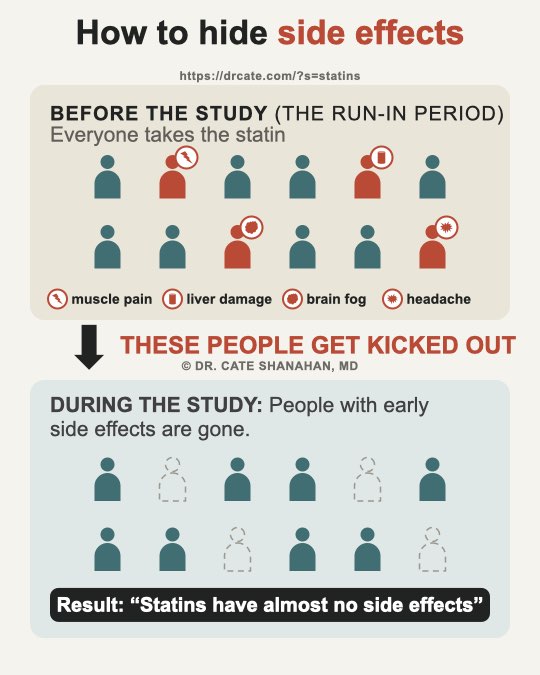
Imagine testing whether a roller coaster causes motion sickness, but first sending home everyone who got queasy on a practice ride. Your official study would find the ride remarkably safe. It would also be measuring the wrong people.
In other words, a run-in period allows statin trials to kick out people with any side effect, no matter how serious. Those who remain are the people who either don’t develop side effects, or didn’t develop them early enough to make the connection to starting the drug.
The biggest statin trial in the analysis did exactly this
The largest trial in the 2026 analysis is the Heart Protection Study (HPS). It accounts for about one in six of all participants on statins or placebo. The 2026 paper even singles it out as backing up its conclusion that statins don’t harm cognition.
Before HPS randomized anyone, every participant took simvastatin for four to six weeks, knowing it was the real drug. The investigators’ rules said that anyone who had, or even felt they had, any side effect was not to be randomized. By the time the actual trial started, more than a third of the people who began the run-in were gone.
The 2016 review admitted that this kind of run-in “may exclude some patients in whom the treatment might cause adverse effects soon after starting it.” Then it waved the concern away. It said reasons for dropping out didn’t differ between the placebo weeks and the statin weeks. But the placebo weeks always came first, and nothing about that comparison was randomized. This is the same group that tells us not to trust any evidence that isn’t randomized and blinded. When the question is whether their own trials filtered out side effects, they’re happy to rely on exactly that kind of evidence.
The 2026 paper doesn’t mention the run-in at all. It simply holds up HPS as proof that statins don’t harm cognition. That proof comes from people who had already been screened for tolerating the drug.
The truth about randomized drug trials: they’re not always randomized
Statin advocates claim that the side effects on statin labels come from unblinded or nonrandomized studies, and therefore shouldn’t count. What they don’t admit is that their own trials were unblinded at the beginning, which is when it matters most.
In my view, these trials were never designed to uncover side effects. They appear to be designed to do the exact opposite: cover them up. And then prestigious journals like the Lancet simply publish reanalyses of the same flawed data, and use them to make even stronger claims.
Statin side effects can start after a long delay, too
If you start getting weak or short of breath or slightly forgetful two years after starting a statin, how likely are you to consider that the statin might be causing your symptoms?
I can tell you this: hardly any of my patients who’ve been on a drug for several years consider that the drug they’ve been taking so long might be the cause of whatever they’re seeing me for that day, be it hives, constipation, cough, headaches, fatigue, or what have you. But just because you’ve been on a drug for years doesn’t mean you’re immune to its side effects. All of those symptoms, and many on the statin side effect list above, can start at any point.
Why this matters
Statins are among the most commonly prescribed drugs in America. Tens of millions of people take one, usually for decades. The side effects in question aren’t minor annoyances. Memory loss, confusion, depression and nerve damage can change who a person is and how they live.
Papers like these can do real harm by lulling doctors into a sense of safety. When a patient on a statin starts losing words, forgetting appointments, sleeping badly or feeling flat, a doctor who has absorbed the message that “statins don’t do that” won’t make the connection. The symptoms get blamed on age, stress or “just one of those things,” and the patient keeps taking the drug.
This isn’t abstract for me. In my own life I’ve watched people who have taken a statin for a decade or more become noticeably more cognitively impaired than their spouses, who are about the same age and don’t take statins. I can’t prove the statin caused it. But I can see what it costs the unimpaired spouse, who now spends their days watching and worrying. And I know how unlikely it is that anyone in their doctor’s office has asked whether the drug might be part of it.
Until trials are designed to catch side effects instead of screening them out, the question of what statins do to our brains is still open.
References
- Cholesterol Treatment Trialists’ (CTT) Collaboration. Assessment of adverse effects attributed to statin therapy in product labels: a meta-analysis of double-blind randomised controlled trials. Lancet 2026; 407: 689–703.
- Collins R, et al. Interpretation of the evidence for the efficacy and safety of statin therapy. Lancet 2016; 388: 2532–61, and its supplementary appendix (webtable of trial run-in designs).
- Heart Protection Study Collaborative Group. MRC/BHF Heart Protection Study of cholesterol lowering with simvastatin in 20,536 high-risk individuals. Lancet 2002; 360: 7–22.
- Heart Protection Study Collaborative Group. Effects of simvastatin 40 mg daily on muscle and liver adverse effects in a 5-year randomized placebo-controlled trial in 20,536 high-risk people. BMC Clin Pharmacol 2009; 9: 6.
- FDA Drug Safety Communication: Important safety label changes to cholesterol-lowering statin drugs (February 2012).
- Pharmacovigilance analysis of atorvastatin and memory loss in the FDA Adverse Event Reporting System. Drugs R D 2024 (link.springer.com/article/10.1007/s40268-024-00474-6).
- LIPITOR (atorvastatin calcium) prescribing information, Pfizer.

Related Posts


This Post Has 0 Comments
Note: Please do not share personal information with a medical question in our comment section. Comments containing this content will be deleted due to HIPAA regulations.