
The 2025 Dietary Guidelines Are Beginning to Acknowledge the Problems with Seed Oils
Table of Contents
Why It Matters That Seed Oils Are Being Recognized as Ultra-Processed
The US Dietary Guidelines will be released in just a few days. They are expected to make a historic change regarding refined seed oils. Departing from decades of guidance that treats these oils as an unqualified nutritional upgrade, they’re calling out the fact that most seed oils are ultraprocessed, and their health effects merit closer examination.
(You may have been led to believe that seed oils’ health effects have been thoroughly examined. They have not. And I’m writing another article that exposes why the nutritionists who claim to cite evidence showing seed oils are not all that bad, or maybe even healthy, do not understand what they’re citing.)

It helped. I feel great.
"It’s helped. I feel great."

This has been life changing
"Let me tell you this has been life-changing. I have all of her books, in audible and ebooks! I have gotten rid of all the hateful 8 oils. I have trained my body to eat its own previously toxic body fat. Download that pod it's a game changer!"

Life changing
Deep Nutrition changed my life.
Saved my life
I would like to thank you for literally saving my life. Back in February, I had to be hospitalized while on vacation in Phoenix with an A1C of 11% and had to start taking 2 types of insulin and 2 other meds. I read the Fatburn Fix in April, and followed the program to a tee, and I’m down by 15 pounds, 6.8 A1C, and only one once weekly diabetes medicine. Prior to reading the book, it was almost impossible for me to lose weight as a diabetic.
I feel free
For the last month, I have really been reading all labels on everything. I have completely remove those 8 oils you talk about. I must tell you, I feel great! I have more energy and I am now 197 lbs (have always been around 205 to 210lbs). I eat potatoes with real butter, grass fed steak, pasta with the right toppings. I eat everything! I seem to crave less sugar. I love it!
I feel so much better
I had terrible aches and pains everywhere in my body, my hands, shoulders and knees. I feel so much better and the way I feel is motivating me every day! Thank you
Better than ever
I am an anesthesiologist in Orlando and a huge fan of both of your books! I have been incorporating your principles for the last 10 months and feel that my health is better than ever.
My allergies disappeared
The biggest difference for me (and a surprising one) is that my allergies have almost completely disappeared! This is a big deal for me, because I’ve had allergies most of my life and they have often affected what I do which is a teaching music in [a public school district]. In general, I feel much better and have more consistent energy throughout the day.
Heart Palpitations have Stopped
I’ve lost 20+ pounds (also fasting 16-24 hours daily) and haven’t had palpitations except for one occasion — I had a mini bag of Fritos for the first time in July. And, I feel better now on a daily basis than I ever did all through college.

I’ve lost over 50 pounds
I’ve lost over 50 pounds. I’m 56 years old. Cutting processed food and unhealthy fats from my diet was one of the first things I did on my health recovery journey...I went cold turkey off the bad oils. Emptied my pantry into the trash and just started eating real food
Knowledge I didn’t know I needed
Your Fatburn Fix book is amazing, my friend. Thank you! I’m an Functional Nutritional Therapy Practitioner and I know my stuff. This is the extra layer of knowledge I didn’t know I needed. Well done!
Lost a solid 20 lbs and my bloodwork is great
I have lost a solid 20 lbs and my bloodwork (after 3 months of eating your way) was even better! I was metabolically healthy (per your book) before I read your book, but barely. Lowering my weight, sealed the deal! I have been talking about you and your book to anyone who will listen...Thank you for all you’ve done and what you continue to do! You are changing lives for the better!
Lost 20 lbs I could never shed
I love your Fatburn Fix! Has helped me so so much! I have had the dreaded weight all my life - 20 or so pounds I could never shed. I have lost that now. I only eat 2 meals a day lunch and dinner with a glass of milk or cappuccino around 4 to hold me over. No snacking and not bad oils. It has been the key to unlocking my fatburn. I work out in the am and believe I am burning fat for energy not from food!
I feel great
My waist is four inches smaller. I feel great and many of the minor aches and pains that I had (knees and lower back) are gone. Also, my muscle tone is amazing, even though I have not increased my workout routine.

The go-to for strength and conditioning coaches
Whenever I advise my clients about eating to perform I go straight to what I have learned from Dr. Cate. Her book Deep Nutrition has become the go-to for strength and conditioning coaches across the country.

Dismantles the lie
Dr. Cate dismantles the lie that seed oils are healthy, which may the biggest lie about nutrition and health because it’s so insidious.

She knows the chemistry
Dr. Cate alerts us to the harms of seed oils and she’s convincing because she knows the chemistry better than anyone.

No one is better at communicating nutritional truth
Dr. Cate has had the single greatest impact on how we talk to people about fueling for both performance or durability. While we all are a little unique, the foundational principles of human nutrition are immutable. If you are looking to create a more durable, resilient body, no one is better at communicating nutritional truth than Dr. Cate.

Highly recommend The Fatburn Fix
Dr. Shanahan has had a significant impact on my practice of medicine. I am known as a Low Carb Doctor, but I never really appreciated the negative effects of processed seed oils on the health of my patients. I highly recommend The Fatburn Fix to my patients and have a loaner copy in my waiting room. It is amazing how quickly blood sugars and overall health improves with cutting seed oils. It is not just about the carbs!

Respected in the sports world
Dr. Cate reordered my diet when I was with the L.A. Lakers, and the benefits, for me personally, were felt immediately and have served me to this day. I’ve come to take real food so seriously I started a small family farm. I know of no M.D./nutritionist more respected in the sports world than Dr. Cate Shanahan.

Brought seed oil issue front and center
Cate brought the seed oil issue front and center. Healthy fats matter. So much so that I created an entire product line to swap out bad fats with good.

Optimal health starts with food
If you want to understand how optimal health starts with food, start with Dr. Cate. Her book Deep Nutrition leaves you with an appreciation of the profound relationship between our genes and the planet, inspiring us to be good shepherds of both.

Helped me with endurance
Deep Nutrition really helped me with endurance. I started to feel better as a player. I was able to run more, I was able to be more active …and I just decided to keep going with it to this day.

Silver bullet for me
Dr Cate’s teachings helped me lose 60 pounds like it was nothing. It was like a silver bullet for me.

Radically improve your health…
Dr. Shanahan has provided a solid reference that deserves a place in the library of anyone who is seriously interested in nutrition. Her perspective on the vital role that healthy fat has in our diet is novel and, if implemented, can radically improve your health.

Pull up a chair…
I have based my work on the idea that getting the right kinds of healthy fats into your body and avoiding the worst fats is essential to optimal health. I've interviewed dozens of the world's top experts about this, and I know of no one who speaks more eloquently on this topic than Dr Cate. If she’s talking fats, pull up a chair. Take notes.
The key to unlocking my fatburn
I love your Fatburn Fix! Has helped me so so much! I have had the dreaded weight all my life - 20 or so pounds I could never shed. I have lost that now. I only eat 2 meals a day lunch and dinner with a glass of milk or cappuccino around 4 to hold me over. No snacking and not bad oils. It has been the key to unlocking my fatburn.
Saved my life
I would like to thank you for literally saving my life. Back in February, I had to be hospitalized while on vacation in Phoenix with an A1C of 11% and had to start taking 2 types of insulin and 2 other meds. I read the Fatburn Fix in April, and followed the program to a tee, and I’m down by 15 pounds, 6.8 A1C, and only one once weekly diabetes medicine.
> Tears of joy
I'm crying tears of joy and appreciation for all you've done for me and my health! Without Deep Nutrition and Fatburn Fix, I would literally still be in the vicious cycle I'd been fighting all my life! In a nutshell - I am no longer a compulsive overeating addict suffering under the crushing 'thumb' of all food and alcohol.
The tiniest shift on this issue, which is basically what we’ve got here, must have faced significant structural resistance. Industrial seed oils are not prevalent because of consumer demand; most people have no idea what they are or when they’re eating them. They’re prevalent because much of our modern food system has been built around producing corn, soy, and canola—the three most prevalent refined seed oils in people’s diets. Seed oil crops are well-suited to large-scale, mechanized agriculture. So today, replacing them with traditional animal fats would wreak havoc with our entire food production system. At the same time, their low cost makes them foundational to the business models of processed foods, fast food, and commercial food service. Taken together, these factors mean that powerful economic interests are invested in maintaining the status quo.
US Farmers Benefit When US Dietary Guidelines Promote Seed Oil
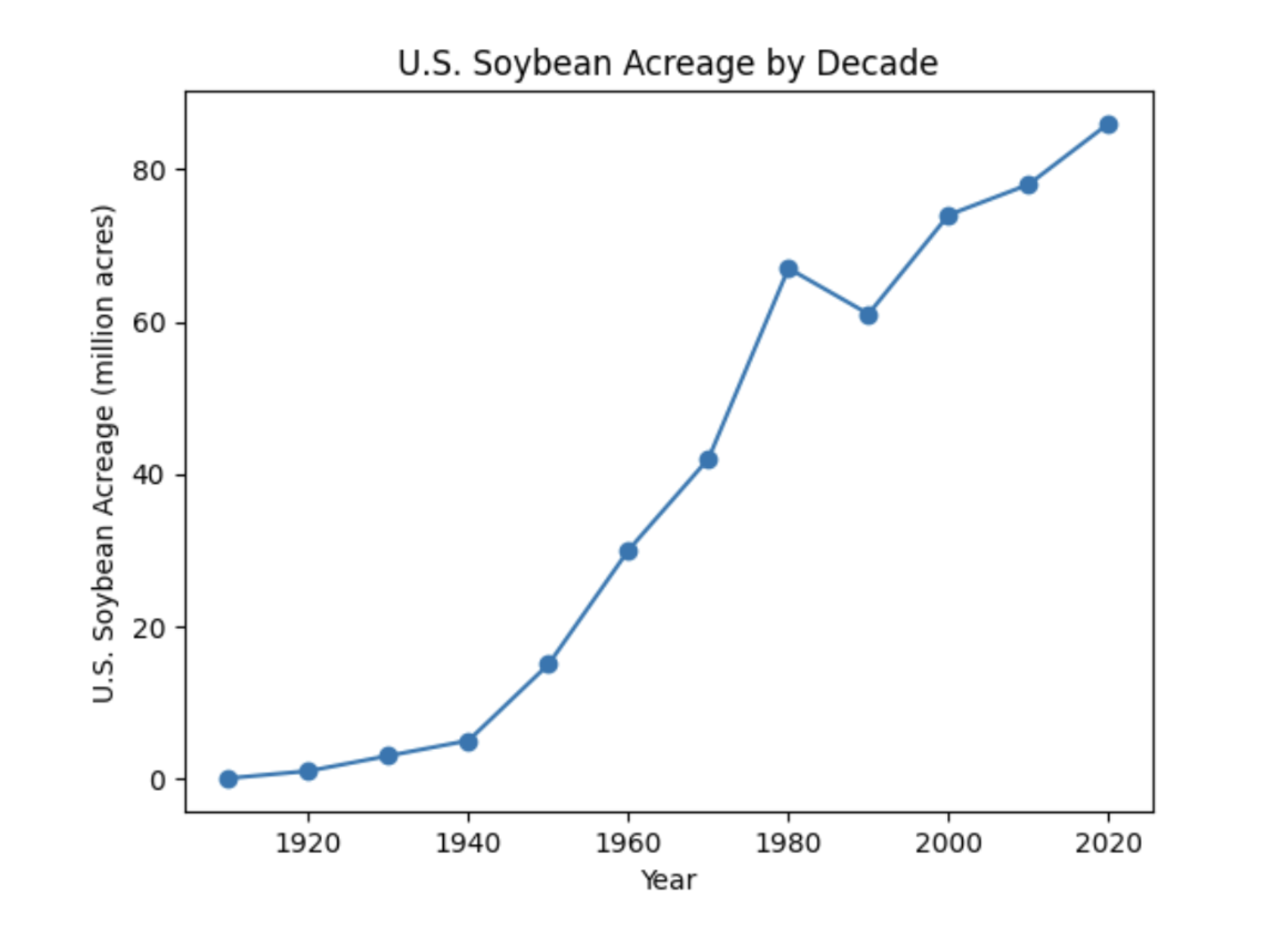
To understand why even tentative recognition of seed oils as problematic has been so difficult to achieve, it helps to start with scale. The first chart, below, shows how the amount of U.S. acreage devoted to growing soybeans (the predominant seed oil in our food supply) exploded during the 20th century, from a marginal crop a century ago to one of the dominant uses of U.S. farmland today. This reveals just how novel the oil is in the human diet, as soybeans were a minor crop in the United States prior to the 20th century.
Soybeans have slowly reshaped our entire food production system. First, by serving as a source of industrial engine lubrication for Henry Ford’s automotive industry, later, for the planes, tanks, and guns during WWII. Following the war, soy oil was replaced by petroleum. But we kept growing soy because farmers had started using soymeal to fatten animals faster than grass could do. Today, soy meal is also used as a meat extender or replacement in numerous processed foods.
The American Heart Association Proclaims Seed Oils “Heart Healthy”
There was really no market for soy oil until the American Heart Association started recommending it as a cholesterol-lowering agent. Thanks in part to their continuing ideology that cholesterol is harmful, we now eat far more soy oil than we do butter, lard, tallow, and all other animal fats combined.
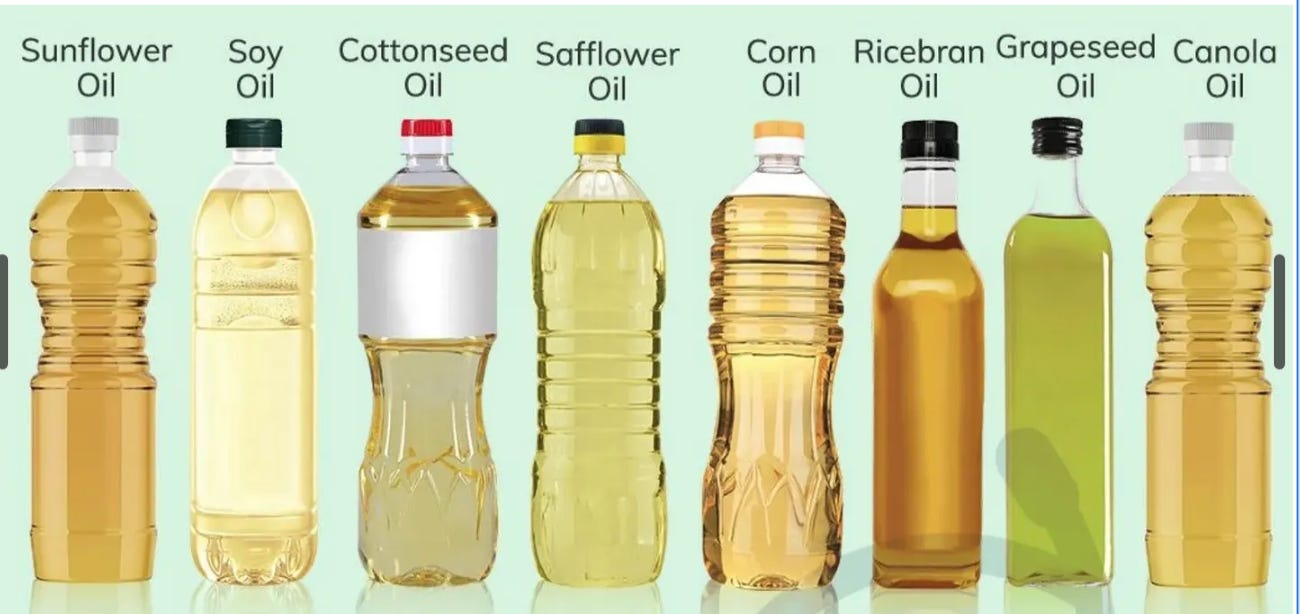
I do not know if the guidelines will define seed oils the same way I do. So, at this point, I want to clarify that there are eight refined seed oils that I’m concerned about: Corn, canola, cottonseed, soy, sunflower, safflower, rice-bran, and grapeseed. (See my previous article for The MAHA Report, here). I borrowed from Quentin Tarantino to coin a catchy term for this collection of problematic oils: The hateful eight.
If you’re not already aware of why they might be harmful, I encourage you to visit my website. You can freely read articles telling the story of how scientists used poorly designed studies to convince a trusting generation of dietitians and doctors that saturated fats caused heart attacks, and seed oils prevented them. I also discuss links between seed oils and oxidative stress that dietitians and MDs like myself do not learn about during our training.
How Previous USDA Guidelines Have Quietly Forced Americans To Eat Seed Oil
While you may not look to the USDA Dietary Guidelines for personal nutrition advice, what they recommend still matters to you—and your family.
Most seed oil consumption occurs without anyone’s awareness, through packaged foods, restaurant meals, and institutional meals. And a good portion of that consumption is essentially mandated by law. You see, USDA guidelines set the defaults for federal food programs, schools, universities, hospitals, long-term care facilities, correctional institutions, and other environments where people eat what is served to them, not what they select from a grocery shelf. Even individuals who go out of their way to avoid seed oils in their own homes remain affected by these standards the minute they step outside to grab a bite to eat.
The second chart estimates just how many people are exposed to seed oils daily in settings where choice is limited because federal guidance directly determines what ends up on the plate. The total estimated captive market is upwards of 50 million. As you can see in chart 2, below, using processed seed oils to make processed foods has been quite a good business model.
Chart #2: Estimating how many Americans have no choice but to eat seed oils on any given day.
|
Institutional Setting |
Estimated People Fed Daily |
Primary Source |
| K–12 School Lunch Programs | 29.7 million | School Nutrition Association |
| Child & Adult Care Food Program (Children) | 4.4 million | Economic Research Service |
| College & University Dining Halls | 10–12 million | U.S. college enrollment & residential meal plan estimates |
| Incarcerated / Detained (Prisons & Jails) | ~2.0 million | Prison Policy Initiative |
| Nursing Homes | ~1.3 million | Centers for Disease Control and Prevention |
| Assisted Living Facilities | ~1.0 million+ | AHCA/NCAL |
| Hospital Inpatients (Average Daily Census) | ~0.51 million | JAMA Network |
| Homeless Shelters (Congregate Meals) | ~0.30 million | HUD point-in-time / shelter census data |
| Inpatient Rehabilitation Facilities | ~0.10–0.15 million | National rehab utilization estimates |
| Psychiatric Inpatient Facilities | ~0.10–0.12 million | Behavioral health census estimates |
| Adult Day Meal Programs | ~0.12 million | USDA CACFP adult day participation |
| Active-Duty Military (Contextual) | ~1.3 million | USAFacts |
| Total (conservative estimate) | ~ 52-55 million |
And remember, we’re not even talking about the fact that seed oils have replaced olive oil, tallow, lard and peanut oil in restaurants, take-out, and convenience foods. The total number of people exposed to seed oils daily, often without realizing it, is much higher than 50 million.
How Seed Oils Impact All Of Us
If you personally avoid seed oil, you may be tempted to think that it’s hardly worth the trouble of fighting huge systems because you’re personally doing just fine. That may be so, for you as an individual. However, we are not islands. We are members of a society. And our society is increasingly disrupted by the burden of sickness. As healthcare systems allocate more resources toward treating chronic illness, fewer resources remain available for acute and emergent care. In practical terms, this means higher costs for everyone, increasing strain on the medical workforce, and reduced availability of timely emergency services—even for those whose own diets are otherwise careful. By calling out seed oils, the new USDA guidance will at least enable us to ask these sorts of questions.
And the first step towards making meaningful evidence-based connections between massive changes to our food supply and massive declines in our health as a Nation is better data.
Seed Oil Consumption Not Properly Tracked
You see, in spite of its ubiquity in the food supply, the government does not track our seed oil consumption. This allows certain academics to claim that we do not eat enough, and then urge us to increase our consumption.
However, independent researchers who estimate our true intake from the only data available have discovered that we eat quite a lot. Along the lines of what you might expect, after looking at the remarkable increase in production shown in my first graph, our consumption has increased 1000 fold between 1909 and 1999. As of 1999, roughly 10–15% of calories were coming from refined seed oils.
Importantly, since 2000, our consumption may have risen significantly higher. In the absence of reliable publications, I’ve compiled my own data using Statista and related sources. I suggest that the figure is now closer to 20-30%. In other words, our intake has doubled in the past 20 years.
Now, let’s look at the changes to just a few of the most well-tracked chronic health conditions during that time. I want to focus on that time period because, as shown in Figure 1 of this publication, other key drivers of metabolic health have been relatively stable in that time period (sugar, flour, red meat), and seed oil is an outlier variable that deserves to be studied far more than it has been.
The new guidelines will, quite likely, lead to better data. Better data will help to raise awareness of the very concerning correlations between seed oil consumption and serious illnesses, including many affecting the brain, as listed in Chart 3. Nutrition scientists have been denied the tools and the permission to study seed oils independently because of previous assumptions about their health effects. This is partly why few people have even looked for the correlation I’m describing, and it’s a necessary first step to identifying potential causative links.
Chart #3 Correlations between seed oil consumption, which doubled between 2000-2020, and serious illnesses that increased in that same time frame.
|
Condition |
What has changed between ~2000 and now, while our refined seed oil consumption doubled |
Key Clarification |
Primary Data Source |
| Child Obesity | Childhood obesity prevalence has increased since 2000 and now affects ~1 in 5 U.S. children and adolescents. | Worse in food deserts, where seed oils are most difficult to avoid. | CDC NHANES: https://www.cdc.gov/obesity/data/childhood.html |
| Autism Spectrum Disorder | Autism prevalence has increased approximately 4–5× since 2000 (from ~1 in 150 to ~1 in 31 children). | Diagnostic changes explain part, but not all, of the increase. | CDC ADDM Network: https://www.cdc.gov/autism/data-research/index.html |
| Parkinson’s Disease | Parkinson’s disease prevalence has risen substantially since 2000; increases exceed population aging alone. | Aging and improved detection contribute, but age-adjusted incidence has also increased. | Parkinson’s Foundation: https://www.parkinson.org/understanding-parkinsons/statistics |
| Cancer (Under Age 50) | Incidence of multiple cancers in adults under 50 has increased since 2000, including colorectal and other metabolism-linked cancers. | Not fully explained by screening or diagnostic changes; overall mortality is declining due to early detection. | NCI / NIH: https://www.cancer.gov/news-events/cancer-currents-blog/2020/early-onset-colorectal-cancer |
| College Student Mental Illness | Reported anxiety, depression, and related mental health conditions among college students have increased markedly since the early 2000s. | Those who solely blame social media for this may be unaware of the newer research showing mental health improves when metabolic health improves. | Healthy Minds Study: https://healthymindsnetwork.org/research/ |
| Infertility | Infertility affects ~1 in 6 people of reproductive age globally; prevalence remains high and may be increasing in some subgroups. | Delaying childbearing explains only part of the burden. | WHO: https://www.who.int/news/item/04-04-2023-1-in-6-people-globally-affected-by-infertility |
Among the most promising causal mechanisms that I’ve been studying are the oxidation products that develop in seed oils, particularly toxic aldehydes. It’s well established that toxic aldehydes in our diets can disrupt mitochondrial function, promote inflammation, and destroy cell membrane integrity. Unfortunately, most dietitians today are not taught that foods made with refined seed oils contain varying amounts of toxic aldehydes, and as a result, deny they exist. This disconnect needs to change. But there are many barriers standing in the way. Those barriers include some of our most powerful industries, listed on chart 4.
Chart #4: Industries that benefit from seed oils being promoted as healthy.
|
Sector |
Representative Companies / Examples |
How They Benefit From Seed Oils |
Why the Status Quo Matters |
| Seed Oil Manufacturers | Unilever, Cargill, ADM, Bunge | Seed oils are cheap to produce, highly shelf-stable, and easily refined at an industrial scale. They benefit indirectly from low, stable oilseed prices created upstream. | Removing or reducing seed oils would disrupt a core commodity market tied to large-scale corn and soy production. |
| Packaged / Processed Food Industry | Kraft Heinz, General Mills, Nestlé, PepsiCo | Seed oils enable ultra-processed formulations by improving texture, palatability, and shelf life at very low cost. | Reformulating away from seed oils raises costs, shortens shelf life, and undermines existing product lines. |
| Food Service & Institutional Suppliers | Sysco, US Foods, Aramark, Sodexo, Compass Group | Seed oils are inexpensive, neutral-tasting, and compatible with centralized cooking, frying, and reheating at scale. | Federal nutrition standards shape procurement; a saturated-fat cap effectively locks seed oils into large contracts. |
| Restaurant & Fast-Food Sector | McDonald’s, Yum! Brands, Restaurant Brands International | Frying oils must be cheap, stable, and reusable; refined seed oils meet operational needs at scale. | Switching fats would raise costs and require supply-chain, equipment, and menu changes. |
| Agricultural Commodity Processors | USDA commodity system; large grain handlers | Oilseed crops provide a high-volume outlet for subsidized corn and soy production. | Dietary guidelines indirectly sustain demand for oilseed crops and their downstream processing. |
| Healthcare & Pharmaceutical Industry | Pfizer, Merck, Eli Lilly | High prevalence of chronic metabolic disease sustains long-term demand for medications. | Nutrition policy that fails to address upstream drivers preserves treatment-focused models. |
| Financial & Investment Stakeholders | Index funds, private equity, pension exposure | Many of the above sectors are heavily represented in broad market indices and institutional portfolios. | Systemic change would affect multiple sectors simultaneously, creating financial resistance to reform. |
| Subsidized Crop Growers | Corn, soy, and oilseed farmers supported by federal programs | Federal subsidies, crop insurance, and price supports reduce risk and encourage high-volume production of oilseed crops. | The status quo incentivizes overproduction of crops whose primary economic value is realized through processing into oils and ultra-processed foods, with much of the original nutritional value lost. |
Our future depends on strategy.
Our culture is addicted to cheap calories, and these industrial seed oils are not isolated ingredients that can be swapped out without consequences. They are embedded across agriculture, manufacturing, institutional procurement, and clinical guidance. Entire supply chains—farms, farm equipment, fertilizers, university agricultural departments, oil refineries, packaged food formulators, foodservice distributors, and institutional kitchens—depend on refined seed oils.
That is why this issue is so resistant to change. A policy shift that meaningfully highlights the need for more rigorous research on seed oils is not a superficial messaging change. It alters what questions are considered legitimate to ask, which determines what hypotheses earn funding. And that’s been a real problem for science itself. I’ve spoken to a number of respected researchers who’ve told me they face constant challenges doing the work they do because the people who decide what grants get funded assume the issue is already settled, and their grant requests get denied.
Explicitly recognizing the ‘hateful eight’ seed oils as highly processed and potentially problematic creates space for proper investigation into their biological effects. If we want to move the needle on chronic disease, we have to move the needle on a nutrition narrative that has a 40-year-plus track record of failure.
Highlighting seed oils as a group that deserves further study is foundational to making positive change. It lifts the structural constraints that have prevented scientists from paying much attention to these oils, and makes much needed change possible.
That is why this moment matters. Not because one policy may or may not change this year, but because it makes clear that progress on chronic disease will require a new research strategy, not just new statistics based on the old nutrition ideology.

This Post Has One Comment
Note: Please do not share personal information with a medical question in our comment section. Comments containing this content will be deleted due to HIPAA regulations.

A friend recently directed me to the theory of “parent essential oil” supplements – – have you heard of these before? The lipid science he cites is somewhat similar to your books, but instead of DHA/EPA the doc promoting this about 12 years ago recommended LA and ALA (with low PV values) so the body can convert them to what it needs. Sounds fishy to me…
Thank you for all your good work. I have close family that has benefited from our better understanding of healthy FA’s.