drcate.com Rotating Header Image

Weight Loss

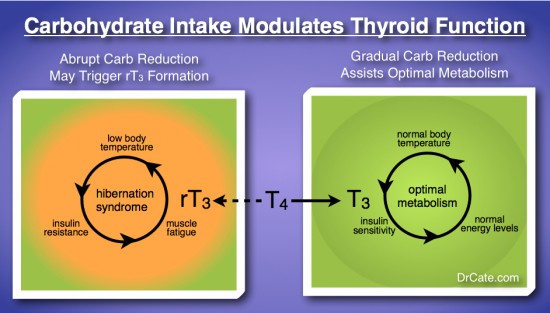
Going Low-Carb too Fast May Trigger Thyroid Troubles and Hormone Imbalance

Don't be fooled by the bread demons, you CAN be healthy on a low-carb diet

If you’ve been turned on to the low-carb Paleo diet craze, you may have noticed increased energy, better digestion and happier mood, and a shrinking waist line. Good for you. But some folks who’ve taken the Primal leap—particularly those who were previously on a high-carb diet—have been faced with unexpected side effects waving them back to the world of bread, sugary fruits and sweet potato casserole.

Interestingly, these side effects include a wide range of symptoms that are nearly identical to symptoms of severe thyroid hormone deficiency. More interestingly, lab tests often show normal or near normal thyroid function. More interesting still is that these symptoms seem to only be relieved by adding back carbs into the diet, sometimes upward of 300 grams—a level I consider to be very likely to harm.

Why is this happening? Is it that low-carb simply doesn’t work for everyone, or is something else going on? (more…)

How Your Diet Affects Hormones: Dr Cate Joins Jimmy Moore to Discuss Optimizing Body Composition and Moods WITHOUT Hormone Therapy

The epidemic of obesity is also an epidemic of hormone malfunction, including thyroid, testosterone, estrogen, growth hormone, cortisol, and more.

Listen to the conversation with Jimmy Moore here!

If you eat a Standard American Diet, not only are your fat-burn enzymes likely to be totally blocked (the technical term is downregulated), your hormonal systems fail to communicate properly and the effect is like a kind of accellerated aging. To address the blocked fat-burn, many turn to low-carb diets and, lately, the Paleo diet. But some do not stick with these diets strictly enough to rehab their damaged metabolism  and switch non-functioning genes back on, and this leads not only to weight regain, but also to continued progression of the underlying hormonal system problems and continued low energy and fatigue.

Many have resorted to hormone supplementation to treat problems like fatigue and weight gain, as well as hormonal imbalances incluing infertility, thyroid malfunction, andropause, menopause, and so on. But I encourage my patients not to rely on these supplementations programs.

Hormone systems are complex and interrelated, which is why supplemementation does not always lead to the expected results.

(more…)

Share

Your 2012 Weight-Loss Resolution: Become a Better Fat Burner

If you are like most Americans, you’ve made plenty of weight loss resolutions over the years and failed to follow through. It’s probably not that you lack willpower; it’s that you never trained your body to burn fat.

If you know someone who made a resolution last year to lose weight and now, this year, you can see that they look more fit, then this means you likely have an acquaintance who has become a fat-burning master.

You too can learn to train every cell in your body how to burn stored fat—including omental fat and that cellulite you thought you couldn’t get rid of—for fuel.

When your body burns fat for fuel it is said to be in a “ketogenic state.” That’s the key to healthy, lasting weight loss. Let me tell you how its done. (more…)

Share

What is the Paleo Diet?

If you are getting into nutrition and are looking for diet books on Amazon.com, you’ll notice that the current best selling diet books tend to fall into two distinct groups: Vegan diet books and Paleo. Chances are you already know what a vegan diet is: No animal products of any kind. You may not be so familiar with Paleo. So let me introduce it to you.

The Paleo diet, also known as the Primal diet or the Ancestral diet, is a low-carb, high-protein diet that’s helping people all over the modernized world rid themselves of excess pounds and prescription medications. If you don’t have friends or relatives following a Paleo diet now, chances are you will very soon.

Unlike other popular diets that have come and gone, the Paleo diet is an attempt to recreate the diet of our ancestors living in the Paleolithic era ten or twenty thousand plus years ago, when people were still largely nomadic and didn’t need agriculture to support their needs for food. Leaders of the Paleo movement hope to move people away from the Standard American Diet and closer toward those foods of our human evolutionary past. You could call it an “anti-fad” diet.
(more…)

Share

Can Coconut Oil Help With Weight Loss (Part 2)

Lately, weight-loss hype seems to have shifted from pills to natural products. Coconut oil, widely touted as the ‘secret’ to effortless fat loss, represents the newest craze. But just how useful is coconut oil for fat loss?

Unlike pills, coconut oil offers real nutrition and therefore has the potential to help your metabolism operate in a healthier way, thereby assisting with weight loss. But whether you can actually lose fat faster by adding coconut oil to your diet depends entirely on whether or not you are already getting equivalent nutrients from other foods.

Breakfast Smoothie: 1 Hass avocado, diced 1/2 cup plain yogurt 1/2 cup whole milk 1/4 cup cream of coconut 8 ice cubes Directions Combine avocado, yogurt, milk, cream of coconut, and ice cubes in a blender; blend until smooth. Effective Carb: 6

For the duration of my ten years in Hawaii, I think I only managed to consume the equivalent of a coconut or two. I DO love the rich, nutty-sweet flavor of coconut in all its forms (fresh, toasted, etc.). But since my personal chef, Luke, was more into using butter and olive oil, coconuts just didn’t make their way into many of our meals. If you’ve read Deep Nutrition, you already know that while in Hawaii I shed about 20 lbs without even trying and that this minor miracle was accomplished (more…)

Share

Nashua Telegraph Reviews Food Rules

Follow ‘Food Rules’ to health

By GEORGE PELLETIER

Correspondent

“Food Rules: A Doctor’s Guide To Healthy Eating” by Catherine Shanahan, MD; Big Box Books; paperback; 165 pages; $12.

Taking the most rudimentary tenets of eating and flipping them over like organic flapjacks, Dr. Catherine Shanahan, of Bedford, illustrates the correlations between “eating mindfully” and establishing an uncomplicated diet – especially as we lumber through the dog days of summer.

“This is a good time of year to be eating healthy,” Shanahan said. “We have access to the farmers markets. People tend to get so excited about them once they’ve read the book.”

An easy yet informative read, “Food Rules,” covers everything from using the right fats or oils for cooking to not wasting food to educated snacking.

As for the simplest morsel that any reader can glean from the book with one quick perusal, Shanahan reverts to the wisdom of grandmothers.

“The idea is: If your grandmother knew how to cook it is probably going to be something that you want to keep doing,” she said. “Especially preparing the more traditional comfort foods, such as soups or roasts, casseroles with vegetables.”

Shanahan also pointed out that grandparents tend to be thrifty and have gardens to grow their own vegetables.

“That, plus knowing how to use spices,” Shanahan said. “So, I suppose this would be the take-home message from the book, which I like to repeat as often as possible: Our grandmothers were the original nutritionists.

“That’s how we got here; because people who knew how to cook, cooked stuff. Our genes developed in that milieu. And that’s now what we need to keep doing.

“If our genetic heritage was such that people ate different things, for example, only ate meat, our bodies and our makeup would be drastically different. But the fact is we are continually evolving, even now, under the influence of this constant stream of carbohydrate-rich foods and calories, that’s why we’re seeing all the diseases that we’re seeing.

“That is an evolutionary process. And if you don’t like that disease-promoting aspect of the process, which I don’t, you don’t want to eat that way.”

The research that went into “Food Rules,” along with its predecessor, “Deep Nutrition,” provided the author with some “earth-shattering” information, which she said, “is basically what I’m telling patients on a daily basis in my clinic.”

Shanahan is quick to clarify that just because Greater Nashua doesn’t have a Wild Oats or Whole Foods market doesn’t mean we have to make sacrifices to eat nutritionally.

“What we do have that those two stores don’t have is raw milk, which is legal in our state,” she said. “And raw milk from cows that are raised on grass is such an amazing super-food, and all products made from that – the butters, the creams, et cetera – are extremely powerful super-foods.

“And don’t forget yogurt, which is very popular. We have access to all this, and it’s affordable. And if you wanted to get that [fresh dairy] in New York City, you couldn’t, because it’s not legal to sell this stuff in grocery stores.

“The other thing that we have in the state is the only USDA-approved slaughter house, which happens to be in Goffstown. For all of the animal producers in the entire state, they have to bring their products there to sell it.”

Shanahan said she orders her food there a month or two at a time, and that meat there is available year-round.

“It’s quality, pasture-fed, not ‘torture meat,’ as we call it,” she said. “This is even better than a Whole Foods store because it’s better and cheaper.”

Other important chapters in Shanahan’s book cover the importance of the relationship between food and diseases, such as diabetes and cancer.

“Often, doctors are under-informed in this area because the science of eating is not something that we learn in school,” Shanahan said. “We attribute things to family history without acknowledging that our family’s eating habits have altered the genetics.

“Diseases such as diabetes, cancer, heart disease and even Alzheimer’s are unmasked when your diet is high in carbs and trans fats and low in nutrients. That’s the common element between almost all of these chronic diseases that I see and treat every day. That’s why I’m so focused on food.”

Shanahan said another reason some doctors don’t jump on the proverbial nutritional bandwagon is because “we don’t really learn what a healthy diet is. We have an upside-down version of a healthy diet, where we learn about things like whole grain, which is actually about 3 percent lower in sugar than refined white flour, rather than focusing on [reducing] the wheats and rices.

“The idea that (whole grains) be the foundation of the diet is very dangerous and unhealthy. That was my experience for the first 10 years of my life in the medical field.”

As Shanahan learned the components of a healthy diet, she said, “That changed everything. You give people the right advice, they get better. It’s a no-brainer.”

Other areas of the comprehensive “Food Rules” cover “do-it-yourselfing” such as making your own mayo or salad dressing. But who has the time?

“Surprisingly, a minority of people will even do that,” Shanahan said. “Because when they’re instructed by somebody who clearly believes what they’re telling them, people step up.

“For example, I have a program called the T..R.I.M. Program – Treatment to Reverse Inflammatory Metabolism – which I started about a year ago, and I’ve had about a hundred people go through, and for those that I’ve seen who make the changes, they remain committed to it. I’ve been so impressed.”

Shanahan cited one participant, a single mother who, without a kitchen and facilitated with only a refrigerator, a microwave and a hot plate, has been able to “do the right things.”

“I’m amazed at how people can adapt,” Shanahan said.

For more information, visit Shanahan’s Web site at www.drcate.com.

the newspaper article is located here;http://www.nashuatelegraph.com/livingbooksauthors/927802-224/follow-food-rules-to-health.html

Share

Bad Behavior has blocked 2724 access attempts in the last 7 days.